Shifting Gears – When Circumstances Change But God Doesn’t

Written in August 2018 as my cancer journey and treatment plan were still in the early stages.

Recently I wrote about having a pantry full of resources to use when I face hard times.  What I didn’t specifically spell out was that I had just received a diagnosis of breast cancer.  My update to close friends had a subject line of “A little bit of bad news, a whole lot of good news”.  And that is what it was. Bad news – cancer. Good news – it’s small, contained, doesn’t appear to have spread, clear path was a lumpectomy and not a mastectomy and so on.  The appointment with the surgeon confirmed this. It was described by various doctors as “run of the mill cancer” or “routine cancer”.

Surgery was a week ago.  I was home by noon. No nausea from the anesthesia. Essentially no pain or soreness. I felt great. The surgeon was sure she’d gotten it all and didn’t see any indication it had spread to the lymph node she took just to be sure.

The followup surgeon’s visit on Friday was supposed to be a breeze – a quick checkup on the way to lunch with a couple of people who mean a lot to me.  The incision was declared good and healing. My arm movement was great.

And then the “but”.

But the cancer has spread to the lymph node.  It was a surprise to the surgeon. And it was a shock to me.  

So once again I’m waiting.  When I wrote about my pantry, I was waiting for the appointment with the surgeon.  This time I’m waiting for the appointment with the oncologist.

There’s still a lot of good news.  This doesn’t change the final result – but it does potentially change the path to get there because it puts chemo on the table as a likely treatment protocol.  

And here’s what I know so far.  

The tears that were a gift before are a gift again.  God is still answering my prayer to restore my tears to me, to give me back that particular expression of emotion.  It’s still primarily a tender, private thing between me and the Lord – but it may grow.

I am not afraid.  I am calm. I’m sleeping well at night.  There’s a peace that does pass understanding and I am in the middle of it.

I am being knit to my Georgia community in new ways – and the deeper community I’ve yearned for here is showing up and pouring out love and care in all sorts of ways.  A desire of my heart is happening (even if I wouldn’t have chosen this particular way for it to happen).

The God who I know loved me and cared for me before the news of the spread is the same God who loves and cares for me after the news.  He didn’t change – and this is not a surprise to Him. I may be shifting gears, but He is not.

I can decide – and cling to – what is true even before I know how the circumstances will turn out. There’s a chance this won’t involve chemo, but whether it does or doesn’t, it does not change the truth about God’s character.  If God is good, then He’s good whatever news comes next, whatever treatment is right, whatever side effects it may bring. It’s not a naive need to say the right thing. It’s a conviction based on years of deep relationship.

I’m going to have to develop my voice in new ways.  I will have to learn to say “I need help”, but also be able to say the harder version – “I’d like help”.  Or “I don’t want to be alone.”

I’ll need to learn to graciously receive the care (and potential wisdom) behind the unsolicited offers of medical advice, while still protecting myself from being overwhelmed.  I desire to be open to wisdom – and I know there are new and non-traditional protocols that may be worth considering. There are options and great stories and things that have worked well for others.  But there will also need to be boundaries to protect myself from too many voices.

I’m going to have to decide who I listen to – which advice-givers, which doctors.  My discernment will need to be sharpened to learn to hear the Holy Spirit’s nudge not just in spiritual matters but in medical ones as well.

Do I play out worst case or “what if” scenarios in my mind?  To be honest, I don’t – with one exception. Will I lose my hair?  What will that be like? Would my Connecticut friends – those long standing friends who are also my rock and my lifeline – be able to come be with me at that point if I needed them?  What is going to be my safe place to get used to that? Will it become a reality?

It’s not an all consuming thought process, but it’s the one I wonder about most right now.  That may change. I don’t really know what to expect.

This is the beginning of a story I would never have chosen.  But I’ve learned – even in the times that have involved real and deep and damaging pain – that the stories I allow God to write in my life are full of gifts, redemption, new understanding of who He is and who I am.  I grow. Opportunities arise to care for others as a result of my experience. I end up fuller, not emptier.

So I’m shifting gears.  My circumstances have changed.  God has not. And in the midst of the uncertainty and waiting, I still cling to my verse:  I know and rely on the love God has for me.  (1 John 4:16)

A Full Pantry

The start of my cancer journey. Posted in late June 2018, a few days after my diagnosis. In the original post I didn’t name the “new situation” as cancer. But that’s what it was.

Then Abigail made haste and took two hundred loaves and two skins of wine and five sheep already prepared and five seahs of parched grain and a hundred clusters of raisins and two hundred cakes of figs, and laid them on donkeys.  (1 Samuel 25:18)

This is an obscure little verse in the middle of the story of the interaction between David, Nabal and Abigail.  David and his troops are on the run from King Saul and low on supplies. He sends some of his men to ask Nabal for food.  Nabal sends back a rude and insulting reply. And David tells his men to prepare to attack Nabal’s home.

Abigail (Nabal’s wife) gets wind of what is happening, takes the action in the verse above, and sends provisions to David and his men.  She averts the attack and it’s the beginning of the unfolding of an unexpected story.

What catches my eye here is not just how Abigail was used in a mighty way.  It’s that she had those provisions ready to go in a crisis situation.  She was solidly prepared for an unanticipated event. She had reserves to quickly tap into.  

What if this image of a stocked pantry applies in ways other than feeding hundreds of people?  

The things I’ve learned, the things I’ve experienced, the things I’ve chosen to make foundations in my life – all of these provide reserves to draw on.  They are available to bring to a new situation. My pantry is stocked. It’s partly just decades of walking with Jesus. But a pantry doesn’t get filled up without some degree of intentionality. Without taking what is outside the pantry (but available) and moving it into the pantry.  So in addition to the years involved, it’s also, at least in part, an intentional lifestyle of choosing to grow and to learn and to press in deeper. A willingness to seek counsel and wisdom from others.  A willingness to “count it all joy” when I encounter hardships. A willingness to cling tighter during the rough times, to run toward Him instead of away from Him. A willingness to accept correction in a way that creates intimacy instead of distance.

Once again, I am facing a situation where my pantry supplies are game-changers.  Once again I’m part of a club that I would never have chosen, on my own, to be part of.  The exact details of what that is don’t matter. What matters is that I have resources which allow me to face this with confidence and hope and peace.  

So what are some of the things in my pantry?

  • An absolute belief that God is trustworthy.  “For we know and rely on the love God has for us.”  It’s my “cling to” verse (1 John 4:16) The Amplified version is even better:  “We have come to know [by personal observation and experience], and have believed [with deep, consistent faith] the love which God has for us.”  I believe this because it has been true in my life, not just because I’m “supposed” to say it. I know for sure that my heart is safe with Him.
  • The “peace that passes understanding”.  It is real and available to me. I don’t have to work hard to get there.  It does not mean there are no tears or no grieving. It doesn’t eliminate emotional fluctuations but it provides a solid base from which to deal with them.  And a place to return to so that I can sleep at night.
  • A courageous approach to hard things.  The realization that not only can I endure hard things but I can thrive in the midst of them.  They are survivable. And not just in a barely make it kind of way.  Sometimes in the middle of it and sometimes looking back after the immediate pain or trauma or hardship, I see that an abundance was built into that season.  And I can endure far harder things than I would have imagined I could. That knowledge is now rock solid in my life.
  • Freedom and joy.  I know at a core level that freedom and joy come on the other side of hard things and they are worth the pain of getting there.
  • Healing that is deep, solid and lasting.  The fruit of the excruciatingly hard work I did years ago has carried forward and I do not have to do that hard work all over again.  New situations do not require me to battle the same old tapes or the same old fears.
  • A fun sense of amazement.  I’ve reached a point where, for the most part, the old fears and insecurities are no longer able to get a foothold in my life.  I’m amazed and delighted. Not only do I not have to struggle against them or work hard to separate truth from lie, it’s just fun to realize what God has done in my life.
  • A relationship with my Father that is pretty free of any sense of entitlement.  When I face tough things, it’s largely because we live in a fallen world. As a daughter of the King I have authority to boldly approach His throne and make my requests known.  And I’m learning to do that more readily. But that is different than feeling I’m entitled to being spared the tough things. “Why me?” has never been a consuming question for me, and I’m grateful for the grace that spares me that temptation.

Full pantries are good things!  “Oh, how abundant is Your goodness, which you have stored up for those who [reverently] fear You.  Which you have prepared for those who take refuge in You.” (Psalm 31:19)

“Scratch and Dent” Jesus

Again, written in December 2017, but moved to new platform in a different season.

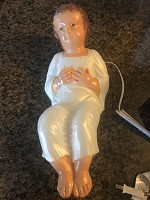
At Christmas, my sister-in-law loves to decorate their yard with an assortment of the older style, illuminated, hard plastic, blow mold figures.  Mr. and Mrs. Claus, reindeer, snowmen, and a Nativity scene. 

Those of us who know her get caught up in her sense of fun and joy.  Her delight spills over to us.  

Unfortunately, a few years ago, someone stole baby Jesus.  (And apparently this is not an uncommon thing to happen in displays like this.)  So I’ve kept my eyes open at flea markets and antique stores but never stumbled across a replacement.  Until …

My sister discovered a website that sold not only new nativity displays, but also replacement figures.  And not just brand new replacement figures.  They had a “Scratch and Dent” Jesus.  The description reads:  Note:  This product will have one or more of any of the following defects: flattened nose, indented nose, paint chips, paint smudge, missing paint or paint splatter.  

I may not “love” the blow plastic molds for my yard.  But I do love a “scratch and dent” Jesus.  This Jesus fits my world better than a pristine, untouchable Jesus.  And it fits me in a season when I have felt a bit bruised myself.  I want a Jesus who knows what it is like to encounter the things that flatten us, or splatter us, or chip us. Who steps right into those things with us. 

The Jesus who was born in a manger, probably more like a cave than the wooden structures we often see.  Among all the smell and mess and dirt of a place that is designed to house animals, not people.  Where swaddling cloths matter because the bed is uncovered straw.

Jan Karon, in At Home in Mitford, shows us a distraught visitor who enters the empty church, sits down, eventually looks upward and in deep agony pleads “God … are … you … up … there?!”  Father Tim slips in beside him and gently says, “You may be asking the wrong question…. I believe the question you may want to ask is not ‘Are you up there?’ but ‘Are you down here?'”

That’s the good news of this season.  That Jesus came. He is “down here”. Immanuel, “God with us”.  And he’s a “scratch and dent” Jesus – not in terms of sharing our sin.  But in terms of sharing our pain and our struggles and the things that hurt us.  Who doesn’t run or retreat when things get messy.  Who takes some of the blows intended for us.  Who binds up our wounds.  Who dwells among and heals the brokenhearted.  

And this Christmas Eve, in the front yard of someone who does love the blow plastic molds, “scratch and dent” Jesus, with his slightly flattened nose, will join the display.  A reminder that the true scratch and dent Jesus has come to bring hope.  And encouraging us to let our joy in Him spill over and draw others into the same delight.

Why Do We Go “There” – When There Are Safer Places to Go?

Originally written in June 2017 as Adventures in Missions was evaluating some world events. I’ve previously posted about risk and safety here as well.

Ask someone to name Bible verses they’ve memorized and Matthew 28:19-20 is likely to pop up shortly after John 3:16.

Therefore go and make disciples of all nations, baptizing them in the name of the Father and of the Son and of the Holy Spirit, and teaching them to obey everything I have commanded you. And surely I am with you always, to the very end of the age.  (Matthew 28:19-20)

So many of us have memorized – and quoted – these verses.  And for some of us, there comes a point when we’re asked to go at another level.  Do we really believe this – ALL nations?  GO?  And suddenly, we have to grapple with deep and potentially scary things. How should Christians deal with fear?  With risk?  With the God-given protective instincts we have for our children?  (And how do we navigate parenting adult children?)

How does wisdom and common sense intersect with a reliance on God’s protection?  Especially when people, particularly younger people, believe they are invincible?  

Has fear compromised the impact of the Church?  How do we draw the “right” boundary lines?  Is there a difference between a call to go into known and likely dangerous situations and an expectation that disciples be willing to lay down their lives if they find themselves in a situation that asks that of them?

Why do we go there (wherever there might be) when there are “safer” options – and kingdom work which can be done elsewhere? 

If we have children who go on mission trips or into humanitarian relief situations, we deal with these questions.  These are good and real and honest questions.  We pray.  We wrestle with the Lord.  International news and travel warnings impact us on a very personal and emotional level.  We have life experience and wisdom our kids may not have – and we have kids, including adult kids, whose boldness and call – and location – may concern us.

How do we align ourselves with God’s heart when there is so much at stake that scares us?  Why should we even consider going into harder, riskier places? I am not minimizing the questions I’ve asked up to this point. It’s important to talk about “if” and “how” and “when”, but can we suspend those questions temporarily?  Set those filters aside for just a while?  What if we ask the “whether” and “why” we should go questions first?

  • Is there a need?  The answer is yes. There is heart breaking and gut wrenching need.  Children in danger.  People being trafficked.  Whole communities in danger from floods or earthquakes.  Refugees who have lost everything.  Poverty levels, illnesses and oppression beyond what we can imagine.  Men and women in physical and spiritual bondage.  And Jesus’ plan is “us”. There is a persistent call in Scripture for more laborers, and for compassion toward the widows and orphans (and other people in need).  (E.g., Matthew 9:35-38; James 1:27; Luke 10:25-37; Matthew 25:34-40)
  • What does scripture say about risk? Scripture is full of people who risked their lives to follow the call of God.  Moses faced Pharaoh at great risk to himself and even though he felt inadequate.  Gideon was fearfully hiding in a wine press when the Lord called him to fight an enemy – and then took away most of his fighting men. Prophets confronted kings who had the power to imprison or kill them. In the New Testament we see Paul and Barnabas described as men who risked their lives for the name of Jesus (Acts 15:25-26).  Paul commends Priscilla and Aquila for risking their lives (Romans 16).
  • Can we learn anything from how Jesus sent out his disciples? Jesus’ disciples were sent out as lambs among wolves (Luke 10:3).  When we are sent out as lambs among wolves, we are sent to bring the Kingdom.  In Isaiah 11:6-8, in the midst of one of the better known prophecies about Jesus, we’re told that the wolf will live with the lamb, the leopard will lie down with the goat.  Going as a lamb among wolves means we live in expectation for the coming of that Kingdom and we want to be part of bringing it about.
  • Is it possible we are the answer to the prayers of Christians around the world? We have Christian brothers and sisters who serve in difficult situations and who face oppression and persecution.  Their stories should not be ignored.  Many of them are pleading with God to send help and encouragement in the form of other believers and workers.  
  • What if going opens our eyes to the plight of others around the world? It is good for our eyes to be opened.  We come away changed.  We are more compassionate and empathetic and proactive.  We become better advocates for change in the world.
  • How should we view martyrdom? This is the one no one wants to talk about.  Martyrdom is historically one way people come to know God.  I don’t believe Christians are supposed to proactively seek martyrdom in the way others (e.g. suicide bombers) do.  And the missions organization I work for places a high priority on managing risk wisely. But in the New Testament we see the martyrdom of Stephen – and we know Paul was a witness to it.  Many of us who are parents of adult children grew up hearing the story of Jim Elliot, Nate Saint and 3 other young men who were killed by a remote tribe in Ecuador – and whose family members went on to live with the tribe and begin to introduce them to Jesus.  It is an inspiring story, but Jim Elliot was someone’s 29-year-old son when he was martyred.  As Christian parents, can we get to the point where we can say that dying on the mission field, if it should happen, is not the worst thing that can happen to our kids?

How do we develop a willingness to hear the Lord say – to us or to our kids – “Go”?  Especially in situations where it seems to us the answer should clearly be “Don’t go”.  Can we start with an honest and fearful prayer of “should they go” – for the sake of the Kingdom or the name of Jesus?  

I am aware of the dangers of implying that you are somehow less “spiritual” if you wrestle with this, or if you hear a “don’t go” after an open and honest process with the Lord.  That’s not my intent.  And I do believe the Lord often says “go somewhere else”.  My intent is to encourage you to press beyond fear, to press beyond even “common sense” for a moment, and connect with the heart of God. To be willing to ask “Is this a time when Your ways are not my ways?”

As I am writing this [the original post in June 2017], we have a World Race squad whose situation is making this real.  Our Risk Management team and Adventures in Missions leadership is evaluating options.  As the parents wait for a decision, Jamie, one of the moms, shared something the Lord did in her:

What I have found very helpful and encouraging today was spending time in worship, that displaces my fear with faith, and reading the Word, which always brings life and light.  Also, revisiting the book Kingdom Journeys and rereading some of the “tough parts” about releasing Racers and embracing our own kingdom journey. One special insight today:  God had me pray for the people of [specific country] and challenged me to this:  “What if the people of [that country] are praying for Christians to come, and what if those Christians are our kids?” Whoa, that was heavy. I spent most of my day praying for my Racer and your Racers, but then He flipped it on me, and said pray for the people of [that country]. I must admit, this is not easy, because the Holy Spirit is trying to give me another perspective and it is not the one my flesh wants to see. God bless you all. Praying for all of you parents too!

The struggle is real.  But it’s important.

A Legacy I Am Grateful For

This was written in January 2017 and now feels very incomplete. Events of recent years means there is much to wrestle with, and educate myself on. And while this is still a legacy I am grateful for, I am more aware than before of how complex the issues are and I need this to be a starting point for further growth.

As parents, we leave legacies for our children. We may be intentional, or even strategic, about some of them. Others may be unintentional – good habits passed along casually or perhaps the painful effects of family dysfunction. But we pass them along.

My parents passed along an important one. Seeing the movie Hidden Figures a couple of weeks ago got me thinking about it. But as I said in the introduction to this revisiting of a 6.5 year old post, it cannot be the place I end.

My parents were high school sweethearts, raised in an area of the Virginia Appalachian Mountains not known for progressive attitudes toward race relations. Raised in families that generally defaulted to the cultural norm of the area.  

After college (Mom) and a stint in the Navy in order to get GI Bill benefits (Dad), they married and settled in Atlanta for Dad to finish his undergrad and then do his Master’s at Georgia Tech. This was the early to mid-50s. And they loved Atlanta – but upon graduation did not job hunt in Georgia. The reason? They planned to have kids and did not want to raise a family in a segregated state. It was a deliberate and reasoned decision. But there were many who thought they were making a big deal out of nothing.

A year or two earlier, Dad had caused a “faculty discussion” at Georgia Tech when, doing an assignment to write a paper on a controversial subject, he had predicted that schools would be integrated within 10 years. Brown vs. Board of Education established that within a year of his paper.

As a 4 year old in 1960, we drove through Georgia on the way to a family vacation and in addition to my first visit to Georgia Tech, I was shown water fountains that still had their “Whites Only” signs. And I was taught what was wrong about that. Another trip, a few years later and around the time of his successful run for Governor of Georgia, we parked on the street of Lester Maddux’s restaurant and Mom and Dad talked about this man, who kept pick ax handles in a container by the door of his restaurant to be used as weapons and who refused to serve those protected by the Civil Rights Act of 1964.

Here and there throughout the years, the message was clearly communicated. Teachable opportunities were looked for. And I grew up without the overt prejudice so prevalent in some circles, particularly for those coming from the same roots my parents did. 

It’s a legacy I am immensely grateful for.

As I moved into adulthood I asked my parents several times what caused them to break away from their culture, and even some of their relatives, that way. Why did they make a shift that many others didn’t make? And they couldn’t pinpoint a reason. But their ability – and their decision – to do that profoundly affected my life.

In the early 1990s, I was living in the suburban Atlanta area. We were taking our kids (ages 3 and 6) to Babyland General Hospital (where Cabbage Patch dolls are “born”). It was a Saturday excursion during the fall, a nice drive and a fun family day. As we came to the town square in Cleveland, GA we saw a full-fledged Klan march. White robes. Pointed hats. Covered faces.  I was stunned – not that it still existed. I knew that it did. But that it was gathered, full force, mid day, in a town an hour from where I lived.

I’m not sure I made as much of the teachable moment as my parents would have. My memory is that I was too stunned – and unprepared – to handle the conversation with a 3 and 6 year old well. But I do know I’ve told them the story as they’ve grown up in the hopes that they will know and will understand. This is not okay.

Hidden Figures challenged me on many levels. It reminded me of a legacy I am grateful for. But it makes me want to think well about the issues we face today. The areas we encounter that are still “not okay”.  

Those who know me, know that I know how to do “sad” much more easily than I know how to do “angry”.  But I feel my sadness shifting a bit – maybe not all the way to appropriate anger, but at least toward a sense that sadness is not enough.  I don’t know what that will look like for me – but I know I’m supposed to press in and figure it out.

Update: This is a challenge to me, one that I have not pursued as wholeheartedly as I think I should. I hope that revisiting this post will help move me in that direction.

The Deep, Rich Beauty of Church “Done Right”

There are so many stories, and so many wounded people, from church “done wrong”. But what I wrote here in December 2016 is my hope for everyone who seeks a church.

I’ve been lucky (or blessed, or both). I’ve been part of a church that while it isn’t perfect, is as close as I can imagine. They have “done church right” in so many ways that my life is different as a result.

And I’m “home” for a quick visit. [Remember, this was December 2016]

This time, for a couple of nights, instead of staying with friends I am staying at the retreat center on the church property. The counselors I saw during the hardest years of my life used to have their offices here. The office where I sobbed and hurt and wrestled and healed is now the bedroom I slept in – and the space was filled with the spiritual presence that permeated those sessions. The memories are not of pain, but of healing and richness and gratitude for this community that embraced me when I arrived, later brought me through the tough times and then sent me out when God called me away. This view, from a bedroom chair as I sip a cup of coffee, speaks peace into deep places for me.

I’m still knit together with this place and these people. I moved to Georgia in 2011 to work for Adventures in Missions but this is my “home church,” my “sending church.” 

In 1994, I arrived in Connecticut and discovered that regional differences do exist. New England is not the South! And I came to love the depth I found here. It fit me well.  I found my Children’s Ministry “voice” here and even now, when I visit, I see young adults that I knew “back when they were kids”. And many of the deep conversations I had with some of them come flooding back. This night, on this particular visit, I spent New Year’s Eve with my small group – and we always laugh a lot but also find a way to have the “how are you REALLY doing?” conversations. Even updating this in 2023, my visits are still characterized by meals and catch up times with the couple who walked me through counseling, spiritual direction and inner healing. Before I leave I’ll have time and conversations with other friends – the lifelong friends where distance may change how we do life together but doesn’t keep us from doing it.

I’ve been well loved by this community. As my marriage was ending and I needed to get a huge house ready to go on the market, 35 people showed up one Saturday and put in over 150 hours of labor – repairing things, weeding gardens, pressure washing patios, packing up all the “stuff” you’re not supposed to have on display when the house is on the market. It was humbling to ask for the help but more humbling to receive the overwhelming outpouring of practical love in action. I can’t keep plants alive so someone borrowed plants, staged them in the house AND kept them alive until the house sold. I’ve shown up on doorsteps in tears and been welcomed in and held as I cried. As I found myself alone at a stage of my life when I had not expected to be alone, I’ve been celebrated on birthdays and remembered on holidays. A number of my supporters (I raise support in order to be on Adventures’ staff) are here. There are prayer warriors who pray for me and for my ministry.

It’s a church that fed me well, challenged me and equipped me. I was encouraged to build and lead a radically different spiritual formation program for children and was supported in that by the pastor and the elders. Learning spiritual disciplines such as listening prayer and true retreats deepened my walk with the Lord. Opportunities were available to grow in leadership knowledge and skills. Conversations with my pastor could be honest and I grew from the wisdom in those and was blessed by the compassion demonstrated in them. There’s a new pastor since I moved and I’m fed as I listen to the podcasts of his sermons and am grateful for his interest in getting to know me.  

This is my story of life in this community.  I know others may have come and gone and not experienced it.  As I said, we’re not perfect.  But I’ve watched this body walk faithfully with so many – through illness, unemployment, good times and hard times. It’s a community that celebrates well, grieves well with each other, and cares well.

Being here reminds me to take a deep breath and to remember that there’s a deep, rich beauty when church is “done right”.

Thank you to the The Barn and to the community here.  You have changed my life in deep and profound ways.  

Known as The Barn, the official church name is Covenant Presbyterian Church; Simsbury, CT, cpcbarn.org

A Manifesto for Parents – What I Believe About Letting Go

This was written by me in November 2016 with heavy input and editing by Seth Barnes, founder of Adventures in Missions. I did not do this perfectly with my own son and daughter, but I do believe there is truth in it.

What does it mean to “let go” of our children, particularly as they transition to adulthood? What does the parental role look like in this new stage? What do we do with the mixture of emotions? What if we just enjoy being with them and we miss them? What about the fear? The “what ifs?” How is a nurturing, supportive parent different from a “helicopter parent?”  When do we extend grace and when do we let them suffer consequences of their decisions?

What does this stage mean for our kids? What do they need from us that is different than what they needed when they were younger? How do we help them develop resilience and other life skills? What if that means solving fewer problems for them instead of solving more problems? What if that means letting them suffer or fail?

What does this new stage mean for us? What does God want to do in us at this stage of our lives? What fills the hole that’s left as our kids move on to more independent lives? When parenting needs to look like cheering from the sidelines instead of directing from center field? 

With strong editorial help from Seth Barnes, I’ve written a position statement, a Manifesto for Parents that we will be using in Parent Ministry. The World Race parents I work with have a journey thrust on them whether they like it or not. I see great responses but I also see harsh and fearful responses. The Manifesto is several pages long and attempts to address the types of questions mentioned above.  [You can find the document form through the link.  But if you’d like to comment, it’s posted in its entirety after these introductory comments.]

While a lot of this comes out of my work with World Race parents, I think it’s for any parent. Those who do wrestle with what letting go looks like. Those who are afraid. Those who are excited. Those who have done it well and can add input to this. Those with younger children who want to be intentional about raising their sons and daughters to be independent adults. Those who don’t struggle with fear but do struggle with how to articulate an answer for the friends and relatives who ask “How can you let them do _______?”

A Manifesto for Parents

As parents, we raise our children the best we know how. We want them to thrive, to have opportunities we may not have had and to embrace the faith and values we hold dear.

This process is not always smooth. For many families, raising children and helping them transition to adulthood is hard. Our children may struggle to find their way or we may struggle to let go.

Too many of us, however well-intentioned, have allowed our own fears to weigh down our children, and our own desires to hold our children back.

Instead of being equipped spiritually, emotionally and in basic life skills, sons and daughters find themselves struggling to leave the nest and fly. They have had their activities and goals chosen for them. Obstacles are smoothed over in the name of being helpful. Too many lack drive and decision-making skills. Their sense of entitlement keeps them from working through setbacks. “Leaving” is challenged by current parenting trends.

Believing parents raise their children in the church but balk at their desire to go into the world to bring light into darkness and freedom to captives.

Has this generation been “parented to death”? Never learned how to take risks? Will they never reach their full potential because their parents never let go?

What Should We As Parents Believe?

We believe it is possible to raise children who find their God-given identity and thrive.

We know:

  • Our goal as parents is to raise our children well, wanting them to become emotionally and spiritually healthy adults.
  • When we make mistakes, we can embrace the grace available to us and live in the truth that God is a God who redeems.
  • Each family is unique and God’s plan for it is uniquely suited to it.
  • The encouragement to “let go” does not dismiss the parental role in appropriately vetting situations or voicing concerns.
  • Letting go is difficult but necessary and is often harder and more unsettling for moms, who typically feel a bigger role shift than dads.

We need perspective:

  • What is God doing in my son or daughter?
  • What does appropriate letting go look like at this stage?
  • What does God want to do in me during this season?

Where We Are Headed – and the Challenges

The reality is, we’re trying to raise adults, not children. Yes, there is a childhood – and it’s an important time of nurture and protection. But our end goal is adulthood.

Scripture is clear as parents we should provide limits, establish discipline, teach the tenets of the faith and nurture our children. We should help them learn faith, self-control, wisdom and discernment – moving them gradually into adulthood at appropriate ages. 

Updated guidelines given to child psychologists show adolescence (the stage between childhood and adulthood) now extends into the mid-twenties and beyond. Skills that a generation ago were learned as part of growing up are no longer emphasized. HR directors see parents intervening in the job interview process. And the traditional church is seeing a mass exodus, particularly of young people.

We have inadvertently parented in a way that contributes to this.

Lack of rites of passage – Rites of passage, which define and celebrate the movement from childhood to adulthood, have essentially disappeared in our society. As a consequence, we have children self-initiating into adulthood. Teen pregnancies and gun violence among youth fall into the category of extreme and unhealthy self-initiation. A wide range of experiences, previously reserved for adulthood, now creep down into young ages. Four year olds getting manicures. The abundance of TV channels and internet options that bring “adult news” within easy reach of children. The line between childhood and adulthood is blurring without the guidance and rites of passage needed to move in healthy ways from one to the other.

Distorted view of what parental love looks like – Today, parenting can appear to be more of a rescuer role, bailing out our children rather than letting them fail and learn from their mistakes. The training role scripture assigns to parents is often lacking. Many of the complaints about ungrateful kids with a sense of entitlement come from the patterns we have set when we remove all obstacles, eliminate consequences, rescue them from hard situations and give them more than they need.

Widespread “failure to launch” – Economic conditions and other factors have led to more kids, of all ages, returning home to live. This is not necessarily bad. But it can delay the normal maturing process, especially when living at home carries very few responsibilities. Scripturally, “leaving and cleaving” applies to marriage, but “leaving” applies to all of us. Abraham left, Moses left, the disciples left their families and their professions. Leaving is part of growing up.

The pressure to succeed academically and it’s impact – The pressure to succeed academically has risen in the last generation. A Nation at Risk (1983) argued American kids weren’t competing well against kids in other nations. This led to more homework, federal policies designed to address the gap and a focus on activities which increase the chance of getting into a “good” college. The 2010 film “Race to Nowhere” documented the pressure. Universities are observing freshmen who, having gotten into an elite university, don’t know how to set a new goal for themselves. Depression levels and dropout rates are rising.

In part because of this pressure, fewer children are contributing to the household. Life skills are not being learned. Some are basic – managing money, cleaning the bathroom, proper social etiquette in diverse situations. Others are more intangible – resilience, wisdom, discernment.

Helicopter parenting – Helicopter parenting can be defined as: (1) doing for our child what they can do for themselves; (2) doing for our child what they can almost do for themselves; or (3) doing for our child something that feeds our own ego or need.

Helicopter parents feel the need to be part of everything – from questioning professors about a college grade, to chastising HR directors when their child doesn’t get a job. On a daily basis, helicopter parents take on tasks that should be done by our sons and daughters, hoping to ease the pressure or just to “help out”. There’s an appropriate helping and blessing role for parents but, in general, it is currently out of balance. As a culture, our children are not learning life skills, self-monitored time management, or how to advocate for themselves in healthy ways.

Hovering parents are different than nurturing parents. Being asked for advice by our kids is different than taking charge of a situation before they have a chance to navigate it. Finding the mix between imposing rules, extending grace and allowing freedom is hard.

What is Lacking?

Resilience – Resilience is the ability to learn from mistakes, to rebound quickly and to try again. This is no longer learned in a culture where children do not have the freedom to fail. Getting a B on an exam leads to suicide. Problems are solved for them. They are protected from conflict. But resilience is highly correlated with healthy executive functioning and the ability to have a “successful” adult life. Our tendency to jump in – while motivated by love – denies our sons and daughters the opportunities to learn to do it for themselves. Our parenting must provide opportunities for our children to learn resilience.

Training in Wisdom (and Consequences) – When decisions, big and small, are primarily made by parents – at an age when our sons and daughters should be learning to do that – young people enter adulthood untrained in wisdom. Let’s model the decision-making process. Then trust them with decisions of their own. They will learn wisdom and the consequences of unwise decisions.

It is scary. An unwise decision as a toddler might result in a skinned knee. As a child it might be regret over wasted allowance money. But as a teenager it could be an unplanned pregnancy or loss of life in a drunk driving accident. Watching as a parent can be gut wrenching.

Discernment – Joyce Meyer says, “Some people think they have discernment when actually they are just suspicious.” Too many of us have the latter but need the former. Our children need to develop the ability to gather information and evaluate options, to judge one choice against another and to factor in faith – all while thinking through consequences. And as parents, we need God’s help in knowing when our children need the opportunity to take risks.

The Changing Parental Role

In the early years, we parent primarily from a positional authority: “I’m in charge because I’m the parent.” It’s helpful, it’s right and it’s good (when properly administered). Babies and toddlers need a protected and more structured environment.

By the time a child reaches their teens, on the threshold of adulthood, if the relationship has not moved to parenting by influence, then there is likely to be trouble. If a relationship of trust has not been built, if they are still “forced” to obey, if they don’t choose on their own to seek counsel – then the ability to effectively parent is limited.

No longer can a parent easily say “You’ll do as I say because I’m your parent.” Physically, they cannot be made to comply. Legally, they have new rights. Colleges won’t share student grades with anyone (including tuition-paying parents) without the student’s permission. HIPPA laws prohibit sharing medical info after age 18 without permission. And so on.

Parents don’t abdicate all positional authority. If we are supporting our son or daughter financially, paying for college, or if they are living at home, compliance with certain rules is part of the deal. Requiring some form of rent or certain chores can help children move toward responsible adulthood.

Wisdom and courage are important here. Some requirements, if enforced, may also create estrangement, at least temporarily. They may choose to leave and move into unwise or unhealthy situations. This is where many parents find it hard to do the tough things that ultimately lead to adulthood. It is excruciating to watch them leave that way and many of us cave in and rescue instead. Knowing when to extend assistance or grace and when to let them fail is no easy task.

This shift from positional authority to influence doesn’t happen overnight. It is not without heartache, but it is essential. The end result is you are becoming brothers and sisters in Christ in new ways. Enjoy this new stage!

Baby Birds Are Supposed to Leave the Nest

Parents are supposed to provide a nest and we know children who do not receive this safe nurturing place in early childhood suffer tremendously. But baby birds are supposed to leave the nest.

The nest-leaving process can be scary for the one needing to leave and for the parent who has protected him or her from the cruel world. It’s hard. But it needs to happen. They are too big for the nest. Something inside them has been telling them this for a while. They sense they were made for something bigger.

Parents may feel protective. A mother’s life has often been structured around caring for her children. There is nothing she can do to stop her natural instinct. The “what if” questions about life outside the nest arise. It’s a normal feeling that needs an override switch.

So how do we do it? How do we let them leave the nest? The world can be cruel. Err too much on the one hand and our naive child may feel thrown to the wolves. Err on the other side and our kids are delayed in growing up.  

Recognize this is normal – All parents whose children grow up go through this process. It’s not easy, but it is the natural order of things.

Grieve it – Loss requires grief. It’s hard to let go, and when we do, our emotions may well lag. Give yourself permission to feel the pain of the loss.

Maintain an appropriate distance – This is not about us. This is about giving our child the opportunity to grow up, develop their own decision-making skills and feel the pain of failure. They need space to be able to figure out who they are.

The Goal of Parenting

Eugene Peterson sees something relevant in the Biblical story of Samuel and Eli (1 Samuel 3:1-10). Samuel had been serving in Eli’s house and one night is awakened by someone calling his name. He runs to Eli asking “What do you want?” Eli, who hadn’t called for Samuel, sends him back to bed. This is repeated a few times until Eli realizes what is going on and instructs Samuel to answer this way the next time it happens: “Speak Lord, for your servant is listening.” Samuel responds that way and the Lord begins to speak more things to him.

Peterson sees a model of what our goal as parents should be: To transfer the primary voice in our child’s life from our own voice to the Lord’s voice. We can’t do that without letting go.

Most of us say “My children really belong to the Lord, not to me.” But there are times the Lord asks “Do you really mean that? Are you willing to act on that?” 

I once put my mid-teen-age son on an airplane for a mission trip when I had a strong sense I would never see him again. This wasn’t wisdom and a need for appropriate protection. This was fear. Despite my fears, I knew there was no appropriate reason to keep him from something he felt called and equipped to do, that had appropriate safety precautions in place. I said good-bye, thinking it was the last time I would see him. He did come home fine, but in the meantime, I learned an important thing. When put to the test, I really did believe my kids ultimately belonged to the Lord. And my own spiritual life changed as a result of acting on that. 

John Piper, a pastor and author, says something along these lines: “Parents, if you are sitting here and your deepest desire is for your children to grow up, get married, live close enough for you to see your grandchildren regularly, and have a house with a white picket fence and good insurance plan – then you might be in the wrong church. We intend to go after your child’s heart and our highest hope is for them to give their heart fully to God and His call. And we expect for some of them this call will take them around the world, into needy and risky places, with no medical care and limited chances for you to see your grandchildren. So decide now. Is this the right church for you?”

Everything in us may know the answer needs to be “Yes” – but the cost is right there in front of us too. This could be a costly “Yes”. How you model this – your “yes”, your letting go, your transition to new seasons – will help your children know how to do it in their own lives.

Fear and Safety

Letting go is often hindered by fear. Something could happen. What do we do with our fear? How should we look at safety? Placing a high priority on safety is not wrong. In fact, it’s wise.

But what if safety becomes an idol?

How do we know if it is an idol? It is an idol if our “yes” to the Lord is held hostage to our requirement for safety. If safety has to be first – no matter what, no exceptions.

As followers of Jesus, idolatry in any form needs to be recognized and confronted.  As Sarah Young points out, ”God detests idolatry, even in the form of parental love.” Anything that supplants the Lord as number one in our lives is an idol. If we felt the Lord calling us to an unsafe place, would we go? If He calls our children, will we encourage them to go? The answer to that is crucial.

The early church, when faced with strong persecution did not ask for safety but prayed “Lord, look upon their threats and grant to your servants to continue to speak your word with all boldness ….” (Acts 3:29)

What does it take to do this?

Understand safety and comfort are not the same thing.  A lack of nice houses, air conditioning, good food, regular electricity, or indoor toilets – or even the presence of things like lice and bed bugs – is not primarily a safety issue.  It’s primarily a comfort issue. 

Don’t operate in fear, calling it “wisdom”. Wisdom is important, but be brutally honest about whether we are really trying to avoid fear by using “wisdom” as a cover. (For example – “I don’t think it is wise for you to …” when we really mean “I am afraid for you to …”)

Live incarnationally. If we follow the model of Jesus, we will touch those we are called to love and live among. Whether or not it is comfortable. Whether or not it is safe.

As believers, we acknowledge both a spiritual realm and a physical realm. Erwin McManus tells the story of his son, who had been scared by demon stories at a Christian summer camp. His son asks “Will you pray God will keep me safe?” Erwin’s response? “I can’t pray God will always keep you safe, but I will pray God makes you so dangerous when you enter a room, the demons flee.”

Are we willing to get there? To the point where we are more concerned about being powerful in the spiritual realm than safe or comfortable in the physical realm? Can we model it for our kids? Or maybe, can we learn it from them?

Next Steps

As hard as it is to let our children go, for most of us this may be the answer to the prayers we prayed throughout their lives. “Please let them grow up to love You Lord, and desire to follow You.” And then they say they want to go overseas on missions, to third world countries without the amenities we rely on, and without regular communication – and the answer to those prayers suddenly looks and feels scary. 

Bless them. They are growing into adulthood, but they still yearn for your approval and blessing. Tell them how you feel about them, why you love being their parent, what godly characteristics you see in them. 

Be grateful for your son and daughter’s desire to follow the Lord. Many of those who are parenting “prodigals” would trade places with you in an instant. The pain of saying goodbye to a child leaving to follow the Lord can pale in comparison to the pain of having children who have rejected Him. Or who live a life filled with unhealthy choices. 

Seek perspective without negating your own pain and struggle. The pain of letting go is real and intense. Military parents face a letting go typically harder than what the rest of us do. Not only do they say goodbye, they say goodbye to sons and daughters being deliberately placed in harm’s way. Parents who have lost children in a variety of ways grieve deeply and wish their children were still here. The call of Jesus is not the only thing that asks us to let go.

Hold your children with “open hands”. As Seth Barnes, founder and CEO of Adventures in Missions, often says, “If we wanted our kids to be safe, we should never have introduced them to Jesus, who is a revolutionary and dangerous world-changer.”

What About the Hole Left in Your Life?

Letting go can create loss. But this can be an amazing season in your own life. Acts 13:36 makes a reference to King David, saying David did not die until he “had served God’s purpose in his own generation”. Our purpose in our generation and in God’s Kingdom is not yet over.

Our journey is about more than just trusting Jesus. It’s about the courage to dream dreams.  Dreams abandoned or put on hold long ago – out of fear, out of shyness, out of “circumstance” or “necessity”. Dreams of mattering and making a difference. Dreams of exploring and adventuring. It’s about the restlessness many of us feel as we enter this stage.

Do these observations ring true for you?

We hit a point of realizing time is short and we don’t want to waste it – We want what we do to matter. We want to leave a legacy based more on significance than worldly success. Complacency may try to tell us we have done enough and we’re entitled to slow down. Or we’re too tired, too old or too unqualified to tackle new challenges. But something in us knows this is not true.

We need to look for new sources of identity and new experiences of trust – Particularly those of us who felt our primary identity was as a parent. “Letting go” of adult children forces us to trust God in new ways. The faith built as we let go builds faith in other areas of our life as well. 

Mistakes or failures may hurt or immobilize us and loss may be very real – It is not too late to grieve well, find healing and grace, and move beyond them. We lose parents or maybe even children, long term marriages end, businesses fail, some dreams die, medical issues may surface. In all of these, we have the choice to run to Jesus for healing or to blame Him. 

Ready to dive in? 

This is an ideal season to expect God to speak about transition, new stages, reviving forgotten dreams or birthing new ones. Along with this comes the need for courage and obedience – especially for risk averse types. Being empty-nesters brings a type of freedom once we adjust.  Don’t waste this window if it exists. It will be gone at some point. Don’t look back with regret.

The world needs our generation to stay activated and engaged in ways far beyond our role as mom and dad. The Kingdom needs us. The next generation needs us. The people affected by injustice and oppression need us.  We encounter hurting people every day. We have a lifetime of resources, experiences and wisdom to bring. 

Conclusion

We love our kids. We want the best for them. Even our missteps are generally motivated by a desire for good and not harm. Their transition to adulthood can be hard for them and hard for us. A healthy process on both sides requires appropriate, and sometimes gut-wrenching, letting go. We don’t lose relationship, but it does change. The end result is worth it. 

Our sons and daughters need us to press through. And we need it as well.

(For references use this link to see this in document, rather than blog, form. Some sections are adaptations of previously published blogs by Seth Barnes and Betty Means.)


Five Years

Originally written in July 2016 on my 5 year anniversary with Adventures in Missions. Revisiting this is a good reminder of my call to go there – and the importance of “call” in general. It’s also a reminder that the journey was still just beginning at that point.

July 15, 2016 was my 5 year anniversary at Adventures in Missions. I’ve been trying to decide if I have anything profound or important to say.

It’s a milestone. I’ve held volunteer positions longer than 5 years, but paid positions are a different matter – in part because of the 20 years I spent as a stay at home mom. The next longest one was just under 5 years. So I’m entering new territory. But there’s nothing particularly profound about that. 

Has it been worth it? Leaving Connecticut, an amazing church, incredible friends? Taking an out of character leap of faith to move to Georgia and work for Adventures in Missions? That’s worth pondering.

It’s the wrong question in one sense, however. I felt a strong sense of call. And a restlessness that intensified rather than abated. In the end, I was acting in obedience to that. “Worth it” is secondary to “call”. I wrestled with it, I wisely waited until certain things were clear, I did not rush into this. And all of those things worked together in very good ways. Ultimately, my “yes” was to the Lord and not to my own desires. A sense of call is the solid foundation I return to time and time again.

But am I glad I did it? Absolutely – a definite YES. It’s been both unexpectedly good and very hard. But both of those things have produced growth and I’m grateful.

I have missed the community in Connecticut deeply – and that has not lessened as time has gone on. In some ways, the longing for it has grown more intense. But I have also learned that I am stronger and braver than I thought I was. 

I have had the opportunity to build a new program (for parents), lead trips and see the world. In many ways, it is more than I ever imagined it could be. But I have also felt misunderstood and the sense that I don’t quite fit in never goes away. I am an introvert in an extraverted environment. I am quiet and I observe well, but the norm here is to dive headlong into things with greater speed. I get from A to B by seeing the obstacles and knowing how to navigate or solve them; but what feels like forward movement to me feels like I’m raining on their parade to others. It’s not about better or worse. It’s about different styles and different giftings. But there have been seasons of weariness in addition to seasons of great delight.

And in all these things I’ve never lost sight of the big picture. I’m called here – to be part of bringing Kingdom by bringing my skills to Adventures in Missions. I’ve grown through the challenges. My view of the world is bigger. I’ve loved the experiences. I love what I’ve learned about God and what I’ve learned about myself.

It’s also been part of God redeeming a season of my life far beyond anything I could have hoped for. With great confidence I can say that this leap of faith, this moving to Georgia, has been good.

Finally, for those of you who have supported me, prayed for me and encouraged me – THANK YOU. My needs go far beyond the financial support I need to raise. Without your love and your prayers and your words of encouragement, I wouldn’t have been able to continue to say “yes”. I treasure the many, many ways you have blessed me.

I believe the “yes” continues – and I can’t wait to see what’s ahead.

When Going Deeper Reveals Subtle Stinginess

Originally published May 2016.

Healthy boundaries are important. This post is not about that. It’s not about the wisdom needed to prayerfully navigate through healing. It’s not about reconciliation. And it’s not about forgiveness.

It is about the quiet voice of the Holy Spirit. A voice that becomes discernible when you pay attention to a nagging sense that what is “right” or “appropriate” is not the whole story. The voice that in this case said “Don’t be stingy with prayer.”

It is, at its core, about asking the Lord why something keeps you unsettled. About running human voices through the filter of His voice and His grace.

Someone who hurt me deeply, someone I have very little contact with these days, recently asked for prayer. And it unsettled me a bit. Almost unbidden, a thought popped into my mind. “That’s inappropriate. This person lost the ‘right’ to ask that.” And on one level that is true. We’re not in the kind of covenant friendship or relationship where praying for one another is part of the commitment and the bond. In addition, it is a situation where certain boundaries are wise and appropriate.

It is not a case of the Lord nudging me to pray and me refusing to do so. That defiance would clearly be wrong on my part – and would say more about my relationship with the Lord than my relationship with this person. The reality is, from time to time I am nudged to pray and I do so. But being asked to pray felt different.

It felt like an in-between space. I’ve forgiven this person. I’m not uncomfortable when life throws us together at the same event. I don’t wish them harm or destruction. If they should be blessed beyond measure, to be completely honest it might be a little bit hard for me but not terribly so.

But being asked for prayer nagged at me. Why?

Trusted and wise friends confirmed that there is a certain awkwardness in this prayer request. They know the story well enough to confirm that I am released from the bond that would “require” me to pray. They affirm that the boundaries I’ve put in place are healthy ones.

But the nagging unsettledness wouldn’t go away. And I’ve learned to pay attention when that happens. It’s important. It typically takes me deeper into the heart of God.

With the help of a trusted counselor, I pinpointed the uneasiness I’d been feeling.

My focusing on what was right or appropriate was subtly edging me toward stinginess in prayer. That’s what didn’t feel right. It’s what felt unsettled.

Stinginess in prayer shouldn’t feel right. I was unsettled because I was being called deeper. Having done the hard work of healing and forgiveness, having let that grow more and more solid, enables a new and deeper freedom to emerge. One that is not governed by the details of rightness or appropriateness. One that more closely resembles the model Jesus set for me.

So it feels different now.  Boundaries? Yes, they are still appropriate. Wisdom? Of course it’s necessary. Being unsettled by a prayer request or being stingy with prayer? That’s what I needed to bring to the Lord.  That, and a continued willingness to wrestle with unsettledness and to be called deeper.

Jesus and Poverty and Dwelling Among Us

Once again, the repost to the new platform doesn’t coincide with the season. Originally written December 2015.

I have a pet peeve. It’s North American children (and adults) picturing Jesus as blond and blue-eyed because that’s the way He looks in their Nativity set. Never mind that the historical record tells us differently.

For years I’ve collected international Nativity sets. A few from my own travels. Most from places such as Ten Thousand Villages. They become part of my Advent meditation. Part of my contemplation of what it means that Jesus became flesh and dwelt among us.

In my Children’s Ministry days I took a different Nativity into class each week during Advent – even when I was teaching 4 year olds. I’d ask them to look at the Nativity and we’d talk about these questions:

What does this Nativity tell us about the people who live in that country?

Why do you think Jesus looks the way He does here? Mary? Joseph?

What does this tell us about who Jesus came to earth for? 

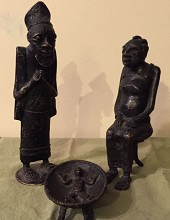
I have a favorite Nativity – and it’s been my favorite since I first laid eyes on it decades ago. It’s from Cameroon and there’s a weightiness to the metal it’s made from.  You see the distended bellies of malnourishment, and the gaunt frames where skin hangs on bones. The poverty is front and center and for some people, it’s jarring to see Jesus that way.

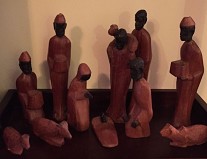
It’s not stately and elegant like the one from Tanzania (right). 

Or interestingly rustic like the one from Indonesia (left). 

But it grips me.  And it touches something deep in me.

Jesus dwelt among us. He didn’t just come to us as someone who will never completely understand what it’s like to live in this world. He became poor in our midst. He comes to us where we are. He understands what we live in the midst of. Even if it’s messy. Even if the poverty – or the hurt, or the shame, or the dreariness of life – overwhelms us. Even if we see no way out.

My poverty is not a physical one. My life, by any standard, is a good one. But my heart still yearns for the One who will come to me, who will dwell with me.

Jesus became flesh and dwelt among us. And through the Spirit, dwells in us today. We have a companion, an advocate, a comforter, a Savior. And it’s good news. For all people.

I’ll admit.  I read about what our World Racers are doing to serve Syrian refugees in Greece.  I hear the stories of the women forced by their poverty into the sex trade around the world. I see abandoned children – here in the States and in third world countries.  Is it really possible that Jesus is good news for them? That we have the ability to proclaim ‘good news to all people’? 

I believe we do. I also believe it can’t be just empty words and a pat on the head. I believe we must act. I believe we must learn to lay aside privilege and become poor in order to dwell among others with compassion and integrity. But it needs to be good news for me before I can proclaim it as good news for anyone else.  And when I recognize my own kind of poverty, when I am so grateful for Jesus’ presence in the midst of that poverty, then I begin to understand what it means to be incarnational. To dwell among those who are not like me.

I want to be overwhelmed, not by my circumstances, but by the love that would come to me in the midst of them.  And this year, I find myself wanting to grow in my ability to be more incarnational in my daily life.  To look for places to bring good news. 

For you know the grace of our Lord Jesus Christ, that though he was rich, yet for your sake he became poor, so that you by his poverty might become rich. (2 Cor. 8:9)