
Waiting … and Advent

One of the issues with moving old material to a new site is that it doesn’t always sync to the appropriate season. This was written during Advent in December 2013.

Typically, we don’t like to wait.  Delayed gratification is less and less common.  Technology and other advances have removed the “necessity” of waiting for many things.  Impulse purchases are a click away online, and for a few extra dollars it can be to you by tomorrow.  Communication that a generation or so ago required the days or weeks involved in writing and sending a letter is now essentially instantaneous, a beep on your phone.  I’m grateful for technology that connects us to each other – especially as families and friend networks spread out to more and more places around the world.  That’s a good thing.  But in the midst of all these advances, waiting falls by the wayside.

We don’t tend to wait well.  Waiting is a nuisance (why haven’t they texted me back yet, why is this line so long).  It’s a necessary evil on the way to the end result and we strive to eliminate as much of our waiting as possible.

But … what if that wasn’t the case?  What if waiting has a richness only to be found in waiting?  What if we miss something by constantly figuring out ways to get “there” faster?

We’re in the liturgical season of Advent right now.  There was a time when the words “liturgical season” meant nothing to me.  “Advent” was a tad more familiar but only because of the Advent wreath at church, pulled out every December with a different family each week lighting it and leading the congregation in a scripted corporate response. 

And then … I ended up in an Episcopal church, one full of life and love for Jesus, full of openness to the Holy Spirit, where “liturgical” became something rich instead of boring, rote repetition.  Something that joined me to the saints who have gone before me and the Church worldwide, that helped me see the bigness of God in both time and space.  A style of connection and fellowship and spirituality and worship that fed a part of me I hadn’t even known was hungry.  That exposed me to the mystery of God in previously unrealized ways.  It’s been over 20 years since I was part of that church but the years spent there were rich ones for me and they left some important marks on my spiritual life.

The Rev. Gray Temple, a profound influence in my life, was adamant that Advent was for waiting and preparation and expectation – and that the celebration needed to wait for Christmas.  Over and over he would say something along the lines of it not being good or right to celebrate too soon.  So during Advent we sang Advent hymns, not Christmas carols.  We sang “Come Thou Long Expected Jesus” and “O Come, O Come, Emmanuel“.  We acknowledged that we were weary and waiting and yearning for His arrival.  The “Christmas play” was not done until after the service officially closed on the 4th Sunday of Advent.  It took me a while to “get it”, to appreciate the reasons behind that.

Before you wonder if I’m a Scrooge, trying to discourage Christmas cheer and December festivities – I’m not.   I love most of them.  And even in my more liturgical years, I was never a legalist about it.  But our pre-Christmas lives are busy ones and they start earlier and earlier each year.  Christmas decorations are in stores right after Halloween.  Store opening times for Black Friday crept back to 5 a.m. a few years ago and then to midnight and now to Thanksgiving Day.  Obligatory gift lists seem to grow longer. 

Being surrounded by so many things that push us to stay busy during this season, how do we find time to reflect on, and to prepare for, the magnitude of the celebration of Christ’s coming? 

God came to dwell among us!  There’s wonder and mystery in that – and we’re in danger of missing it.

How do we grasp that?  What do we do with the wonder of that?  How do we truly celebrate what is worth celebrating?  Can we really rush, rush, rush, up until Christmas Day, and truly be ready for His coming – at least in the ways that matter most?

Hundreds of details and too many obligations can end up minimizing the celebration of His birth – almost reducing it to one more thing on our “to do” list.  What do we miss when we bypass the waiting, the growing anticipation, the building excitement or when all of those things are focused on our plans (even good ones like family being together) instead of on His birth, His entry into our lives?  What happens when we celebrate too soon and in ways that rob the true celebration of its deepest and fullest joy?

How do we keep celebrations from creating a “tyranny of the urgent” which is far different than true, heart-level, preparation? 

Not all waiting is the same.  Some waiting is joyful anticipation with a clear end date – World Racers are about to return home after 11 months away, a small group of cherished friends has planned a vacation for next February, kids are going to be home for Christmas.  Some waiting is more serious, imposed on us by circumstances – waiting for medical test results that can impact what our family is going to look like in the coming year.  Some waiting is tied to hopes and dreams that we may not see fulfilled in our lifetime. 

But Advent is about discovering the hope that is inherent in waiting.  About acknowledging weariness and yearning.  About learning that we are not alone as we wait, even if God seems silent.  Is it possible that Advent can help us learn to wait well in other circumstances?

At this time of year, especially, I love the stories of Anna and Simeon.  Much of what I learned about the richness of Advent, I learned from letting the few verses about their lives sink down deep in me.  I see people who waited well.  They had waited decades for their Messiah.  Anna had devoted herself to worship and prayer, Simeon was full of the Holy Spirit and had been promised by God that he would live long enough to see the Messiah.  Their pressing into God during their waiting time gave them spiritual eyes to see what no one else in the temple saw that day.  They recognized who Jesus was – at a point when He was just a baby, looking like any other baby being presented.  When other eyes did not see what they saw.

That’s what I want.  I want to wait well, to anticipate well, to get more and more excited because I am waiting in the company of God for something worth celebrating, something that invites me into the mystery of God in glorious ways.  I want to be still while I wait, remembering His past faithfulness and wondering what new thing He is doing now.  I want to let Him know where I am scared and where I am excited.  

I want to dream about the moment when the waiting is over but I don’t want to miss the gifts of the waiting time.  I don’t want to miss His comfort, His companionship, and His excitement over the coming gift.

Reminders help me.  So every Advent I set out Advent candles.  Not the skinny ones I grew up with in church, lit on Sundays only.  But big fat ones that can burn for days.  They stay lit most of my waking hours at home and serve as a reminder when I walk through my house that there is something going on in the waiting time that I don’t want to miss. 

And when the time came for their purification according to the Law of Moses, they [Mary and Joseph] brought him [Jesus] up to Jerusalem to present him to the Lord ….  Now there was a man in Jerusalem, whose name was Simeon, and this man was righteous and devout, waiting for the consolation of Israel, and the Holy Spirit was upon him.  And it had been revealed to him by the Holy Spirit that he would not see death before he had seen the Lord’s Christ.  And he came in the Spirit into the temple, and when the parents brought in the child Jesus, to do for him according to the custom of the Law, he took him up in his arms and blessed God and said, “Lord, now you are letting your servant depart in peace, according to your word; for my eyes have seen your salvation that you have prepared in the presence of all peoples, a light for revelation to the Gentiles, and for glory to your people Israel. …”  And there was a prophetess, Anna, the daughter of Phanuel, of the tribe of Asher.  She was advanced in years, having lived with her husband seven years from when she was a virgin, and then as a widow until she was eighty-four.  She did not depart from the temple, worshiping with fasting and prayer night and day.  And coming up at that very hour she began to give thanks to God and to speak of him to all who were waiting for the redemption of Jerusalem.  (Luke 2:22, 25-32, 36-38; English Standard Version)

What Are Kingdom Dreams? (Or, Why Am I Afraid to Dream)

I’ve gotten better, since this was written in October 2013, about dreaming. But it still doesn’t come naturally to me.

Seth Barnes poked his head in my office this week [in 2013] and said, “What’s your Kingdom dream?” 

“Kingdom dream” is a phrase we hear a lot at Adventures in Missions.  For a while we had a department (now rolled into several other departments) called Kingdom Dreams.  We launched the Dream project, helping WR alums with Kingdom dreams to connect with business people for mentoring and offering the chance to possibly receive some funding.

But when I’m put on the spot by Seth, I’m not sure how to answer.   Why am I more comfortable talking about my journey than my dream?  Why is the journey clearer for me than a destination? 

There are things I’m passionate about and feel called to – parent ministry, for example.  But is that in itself a Kingdom dream?  It doesn’t feel specific enough.  So I’ve been thinking – what do I want for parents?  I want them to feel cared for and understood as they face both the excitement and the apprehension/fear of sending their World Racers off.  I want them to delight in their role as the parent of adult children – able to make the parenting shift required at this stage.  I want them be stretched and to grow in the Lord – and to be excited about what He has for them in this season.  I want to encourage them to explore the restlessness that He might stir and to take their own steps of faith.

Is it okay to say that’s my Kingdom dream at this moment?

But the question of my Kingdom dream still nags at me.  What Seth meant as an offhand question has stirred something in me that is unresolved. 

An assortment of thoughts and questions crowd my thoughts.  Why can’t I definitively name a Kingdom dream – something that God entrusts to me (as opposed to something I just wish would happen)?  Don’t misunderstand me.  My life feels rich and full and I love what I get to do.  But Seth’s question triggered something.

I know that I’m afraid to dream.  I also know I’m supposed to wrestle with this a bit.  The Lord is nudging me to confront my fear of dreaming.  I can plan well.  I can serve well.  I can build great programs.  But I have a fear of really dreaming. 

I’m hesitant to ask the Lord for something that I’m not already pretty sure is likely to happen.  It’s rooted in my desire to “get it right”, to not want to ask for the wrong thing.  But it shuts down dreaming.

There’s another factor that shuts down dreaming.  I don’t yet fully believe He would really use me in the way He uses others.  I don’t feel “special enough”.  There are deeply buried dreams that I’m afraid to talk about, even to Him.  I don’t even ask if they are His Kingdom dreams for me because it feels presumptuous to even think He’d use me that way.  It’s not humility.  It’s fear, and lack of trust, and a performance based mentality that looks at my shortcomings instead of His empowerment.

So – do I have the courage to begin to dream in new ways?  To be honest, I don’t know.  But I hope so.  I know this restless feeling.  I know it’s from the Lord.  And I know it’s time to ask Him to keep me unsettled until I finally learn that it is safe to trust Him with my deepest desires and dreams and to trust that out of that, He will entrust me with His Kingdom dream for me.

Sometimes I Miss Children’s Ministry

Originally written September 2013. And while I believe my season of children’s ministry is over, that time of ministering primarily to children was a sweet season for me. And there are parts of it that will always tug at my heart and things about children’s ministry that I remain passionate about.

I absolutely love what I’m doing now.  Working with parents, at Adventures in Missions, is a perfect use of my skills and passions.  It’s a season of ministry that is exciting and fulfilling.  But once in a while, I miss my years in Children’s Ministry.  I loved the 10 years or so that I headed it up at my church in Connecticut and I’m still passionate about a high vision of spirituality in children. 

While walking my dog today, I ran into a couple of young girls in the neighborhood who had a helium balloon on which they had written “To God and Jesus”.  Tied to the string were notes they had written to God and Jesus.  They were walking outside to let it go.  We talked briefly about what they had written.  It started me reminiscing about my children’s ministry days.

One of my former Sunday School kids is now on the World Race.  I remember her compassion – and her persistence – as a 5th/6th grader.  Her desire to make a difference.  There were children in need in the world and we weren’t doing anything.  She made a difference then and she’s grown into a young woman who is making a difference around the world.  I love the possibility that I helped nurture that a bit.

An article was forwarded to me this week about intergenerational ministry.  Immediately my “soapbox” speech came to mind.  I believe deeply in age appropriate teaching, but I also believe deeply in intergenerational ministry.  I want children seeing their parents worshipping and living out their faith.  Too many churches keep the ages segregated.  Too many family calendars have everyone constantly going only to their own age peer group.  It’s why I started a “family Christmas party” when my kids were toddlers and why I pushed for fuller participation/service by kids on work day at church (rather than child care) and why I loved that our church mission trips transitioned from youth group trips to family trips.

I hear from my sister-in-law about the amazing things that happen in her Children’s Ministry program and I miss those days of introducing children to Jesus, helping them go deep, letting them ask real questions and having real discussions – not the “Sunday School answer” kind of discussions. 

I see a post in a Facebook group from someone talking about being raised in a harsh, fundamentalist church and I hear the familiar tale of someone who struggles to believe that God can be gracious and friendly.  And it makes me grateful that I was introduced, as an adult, to a spiritual formation program for children that emphasizes falling in love with Jesus.  I’ve seen the difference it makes in children when their spiritual formation is grace-based, when they first meet the Good Shepherd who loves and protects and calls them by name.  When their first image is not of a judge who is only watching to see when they get out of line.  I hope I’ve poured the love and grace into the children I taught and the teachers I trained.

I remember being at a church where, during the offering, the ushers bypassed the row in front of me because it only had kids in it – and I saw the disappointed look on their faces as they had no way to give their offering.  And one of them said to another “It’s because we’re kids.”  I may not be working in children’s ministry any more, but I still ache at the thought of other kids experiencing the same dismissal. 

I also remember the 4 year old, an “active” little guy who was a challenge.  After a listening prayer time with the class, I asked whether any of them heard Jesus say anything to them that they’d like to share.  This little guy said “Jesus said, ‘I love you and I never ever get tired of being with you.’”  Into that little 4 year old heart, Jesus spoke just what he needed to hear to combat the hurts he was already aware of.  My heart soars when I see young children hearing God in such a powerful way.

I’ve realized that my Children’s Ministry days, and later on my time as a college counselor (on the high school side), had pieces to them that are similar to what I do now.  Throughout it all – I have loved ministry to parents.  Whether it was young children, high schoolers about to go off to college, or World Racers traveling the world for a year, I have loved two particular components of parent ministry:

  1. Helping parents see – and respect – what is happening spiritually in their children.
  2. Helping parents know what appropriate “letting go” looks like at different stages.

To get to do what I do now is a gift – as were the years of ministry that led me here.  I’m grateful beyond measure that I got to do Children’s Ministry and that I loved it.  In God’s goodness, each season of ministry has in some way prepared me for the next step.  Some of the transitions were happy and exciting ones.  Others came out of hardship.  But in all cases, the new ministry season has been one of growth and fulfillment.

Is this season with Adventures in Missions, and parent ministry, my last big season of ministry, the one where I will invest myself for as long as I am able?  I think it is.  But who knows?  I’ve been surprised before. 

Update: It’s 10 years later. I’m still doing Parent Ministry and I still love it.

Responding to Disappointment

Re-reading this, originally published July 2013, brings back the pain of that event. But the “work” I did to get to this response to disappointment has made a bit difference in my life.

Something happened this week [remember that this was written 10 years ago] that was a crushing disappointment.  But let me be clear right from the start – it was disappointment.  It was not huge injustice.  I was not the victim of abuse or extreme mistreatment.  It was “just” disappointment.  In the big picture of problems in the world, it’s not huge.  For other people it wouldn’t have been more than a minor bump in the road.  For me though, it was crushing.  It caused tears to spill over for more than one day.  I’m well aware that in some ways my disappointment was out of proportion to the circumstances.  I’m normally pretty even-keeled.  This doesn’t happen often.

The specifics matter less in this space than the thoughts about handling disappointment in general. In fact, not playing out the details on this page is part of what feels right in this situation.  This is not about building a case or arguing rightness or wrongness.  So I won’t be sharing details.  What I want to share are the thoughts I have about facing and working through disappointment.

1.  I take responsibility for my own baggage and my own reactions.

There are reasons why it hit me so hard that are not the responsibility of the people who caused the disappointment.  If it triggers past hurts – that’s not their responsibility.  It is mine.  Does it bring back old lies?  I’m the one who needs to battle that.  If it was going to fill a hole in my life and now that won’t happen – it’s not their responsibility to fill the holes in my life.  Does it injure my pride?  That’s my issue, not theirs.  Do I have an inappropriate sense of entitlement?  If so, it’s my responsibility to take care of that.

It is also my responsibility to treat all involved with respect.  And to extend grace to those making hard decisions.  And to not gossip.  Some of the reasons for this decision make sense.  Others are still confusing to me.  But I am responsible for my own actions in response. If I act poorly, I can’t blame it on how disappointed I was or whether it should have happened the way it did.

2.  I allow myself to grieve.

I think it is okay to grieve as long as the grieving moves in the direction of healing and not in the direction of bitterness.  And as long as I don’t get stuck in it.  I won’t get to do something that was already a hope deferred, something I wanted to do months ago and was told I needed to wait.  Because of this opportunity, I had made the hard decision to pass up another one – and the one I hated to say “no” to is now too late to jump into.  So my summer has a huge hole in it.  And there are legitimate things to grieve. 

3.  I decide if this is something appropriate to fight for, or to ask for reconsideration.

There may be times when it is right to ask questions, to advocate for a different outcome, to appropriately ask for reconsideration.  This was one of those times.  It does involve something I’ve poured my heart into, a dream I’ve had for years.  There are legitimate reasons to discuss the situation and there are reasonable questions to ask about the decision.  And I’ve now had those discussions.  In this case, nothing changed.

5.  I decide when and why to stop asking for reconsideration.

Along with deciding there’s a time to push a bit, to advocate a bit, to hope a bit that the decision might be reversed – there’s another question.  When is it time to stop?  And what are the right reasons to stop?  I think sometimes you stop because it’s not the most important battle to be fighting – i.e., you choose your battles.  Other times, I think you stop when you make the decision to just be a good sport about something that didn’t go your way.  And then there are times you stop because you choose to trust that the Lord holds your heart and your dreams and your coming in and your going out. 

6.  I choose not to stay stuck in disappointment and to make choices that move me forward.

How do I do that in practical terms?  I need to talk to people who can help me through it – while being careful to not cross the line to gossip.  But they can only take me so far.  And while it is tempting to continue to rehash it in front of supportive friends, I’ll get stuck if I don’t move beyond that.

There’s internal work that only I can do.  I remember the big picture.  I go back to the things that give me perspective.  I run toward those things and not away from them.  It’s part of choosing to move through disappointment rather than stewing in it.  So I make sure I spend extra time with the Lord rather than finding excuses to avoid it.  I know that time with Him brings peace.  So my choices point to whether I desire peace or self-pity.

And then, in this case, I temporarily removed myself from the situation.  As I struggled a bit to find my way through, I took a break.  I got out of town for a day.  I went somewhere I’d never been before.  I created a situation that took my mind off the disappointment.

Three days after getting the news, am I still sad?  Yes.  But not so much.  Does it still sting?  A bit.  But I’ve begun to reframe the rest of my summer to include something I wouldn’t have had time to do before. 

And I’m grateful for friends to talk to, a job I really do love and a Lord I can trust with my heart, who calls me out of disappointment and into peace.

Words to Cling To

Originally published in May 2013. I still love words. The examples of words I cling to have grown in the last ten years – some might pop up on a future post.

I’ve always loved words.  And crossword puzzles.  And word games.  I like to edit and wordsmith documents – to find just the right combination of words.  Putting words on paper, in the form of letter writing or journaling, is therapeutic for me.  It brings peace.  It helps me hear the Lord’s voice.

Words from friends and counselors and mentors bring life.  And challenge.  And hope.  “Words of affirmation” is one of my love languages – but they must be sincere, not manipulative or grudging.  Like the description of Mary after Jesus’ birth, I treasure them in my heart. 

Words matter. 

I have a few words I cling to.  Many of them came to me in painful times and now return to provide comfort when a remnant of the original pain resurfaces. 

Other words are about hopes and dreams – things spoken over me that I desperately want to be true and I hang on to them in hopeful expectation of what the Lord will unfold in my life.

“The sorrows for the appointed feasts I will remove from you.”  (Zephaniah 3:18, NIV)

This is a promise I’ve clung to over the last couple of days.  You see, Friday should have been my 33rd wedding anniversary.  [Note – this was written 10 years ago so the timing is off.]. But it wasn’t.  I’m at a point where, most years, the date has begun to come and go pretty easily.  Some years, however, the tears come to the surface quickly and unexpectedly.  Not for days.  Sometimes not even for hours.  But in the midst of a rich and full life, they are an almost surprising reminder of the pain.  This was one of those years.  So I clung to the promise the Lord had given me – that He will remove the sorrows for the appointed feasts.  I know the original context was a bit different, but I also know when I first read this years ago, my heart leapt.  It was a promise to me in my pain.  A promise to remove the sorrow of anniversaries that should have been … but aren’t.

There were other words that made a difference.  The new friends who discovered my day was tough and who made easy conversation as we worked together on something.  And the words I put into an email to a friend, asking for prayer, and the response that brought tears of gratitude for how richly God blesses me through the people in my life.  There were the quick text messages of encouragement from those who understand.  And the opportunity to be with old friends, and with family, and to talk about memories of life lived together when our kids were all young. 

And, just as I knew it would, the pain passed.  The words brought comfort – and new things to treasure in my heart. 

The Long Haul

Although I wrote this originally in April, 2013, a recent study of Joshua brought it back again – with the challenge from the Lord to “ask for my mountain” now. I talk a bit about a corresponding challenge from Joshua here. And I’ll talk more about this specific challenge as I start to add new material.

I remember the first time I identified with a Biblical character.  Truly identified – as in “Maybe there’s someone like me in the Bible.”  Or “Maybe there’s someone in the Bible that my life could look like.”  I was 18 years old and it was Caleb. 

Moses sent spies into the land God had promised them.  On their return, Caleb is the first one to say, “Yeah, the inhabitants are big and scary.  But God promised this to us.  We can do it because He promised it.”  A bit later Joshua voices the same opinion.  But they are the minority.  They are overruled.  They wander the dessert for 40 years with their companions.  There’s a promise given – Joshua and Caleb will be the only ones from their generation to enter the promised land.

And so, 40 years later, they do enter the promised land.  In the intervening chapters in the Biblical record, we’ve heard almost nothing about Caleb.  But we’re hearing a lot about Joshua – the new leader of the Israelites, filling Moses’ shoes, making “as for me and my house” speeches that are recorded for history. 

Another five years go by after they enter the land.  Caleb comes to Joshua and asks for his inheritance.  “Can I have my mountain now?  The one God promised me?”  And Joshua blesses him and gives him Hebron.  Caleb’s waited 45 years for this.

So why did I identify with Caleb 39 years ago (now 49 years ago) when I first encountered him?  I was an extremely shy, very fearful, very timid, 18 year old.  I knew I was not a Peter or a Paul or a Moses or an Elijah or a Joshua.  But Caleb – maybe I could be a Caleb.  I resonated with his sense that God was trustworthy (He said we can take the land) but also with his inability to pump up the crowd to agree with him.  And with the fact that he was the first to say it, but Joshua “got all the credit”.  And the fact that he’s largely “invisible”, people don’t seem to see his potential.  And the fact that he served quietly – and probably contentedly – in the background.

But he is also described, the few times that we hear about him in Scripture, as someone who wholeheartedly followed God.  He’s commended for that.  The God who sees the invisible person saw that Caleb was faithful and his heart was wholeheartedly toward God.  That gave me hope.  I knew what I couldn’t ever conceive of being.  But this gave me a vision for what I could be.  One that seemed to fit how I was made.

Caleb was in it for the long haul.  In Eugene Peterson’s words, there was a “long obedience in the same direction”.   And in the end, there was boldness to ask for the fullness of his promised inheritance.

So I find myself on that journey – long stretches of invisibility, more “behind the scenes” work than “up front” work.  But with a hope of being called faithful, wholeheartedly devoted to God.  It’s not a works mentality.  I’m pretty solidly entrenched in the grace message.  It’s not “Maybe if I’m good enough God will say that.”  But it does have to do with being content with how God views my heart, with letting go of finding my identity in titles or praise of men.  With making sure that in the busyness of life, in the midst of using my gifts for the Kingdom, that I don’t forget to love Him and listen to Him and follow Him – wholeheartedly.

So much goes on in the years of a journey.  Caleb’s was largely a journey in the wilderness and I think many of us go through a wilderness on our way from here to there.  But even a wilderness journey is not all about drudgery.

You grow.  You serve.  You deal with pride.  You laugh.  You cry.  You discover what you are gifted in – and what you’ll never be great at.  You are stretched in new ways.  You see God work in unexpected ways.  Other times you can’t figure out what He’s doing.  You weep with those who weep and you rejoice with those who rejoice.  You see fairy tale beginnings fail to have fairy tale endings.  You celebrate births and you deeply mourn untimely deaths.  Your heart overflows with joy at times and it breaks with sorrow at other times.

Through it all, I think of Caleb, and realize that being someone who wholeheartedly follows God is a good goal, one that fits how I am made, that doesn’t require me to morph into an extroverted, highly visible and animated leader in order to have value.  And it has me wondering whether I’ve asked for the fullness of my inheritance yet.  Caleb finished strong.  He continued on to do great things after getting his mountain. 

So that’s what I want.  To wholeheartedly follow God.  To desire (and ask for) my full inheritance.  To finish strong.

What Does God Want To Do In Your 50s?

THIS WAS 10 YEARS AGO – so I’ve now turned 67 (earlier this year). Look for an update coming later this year. Originally published 3/17/2013.

I turned 57 this week [Remember – this was 10 years ago].  Seven years before that, shortly after my 25-year marriage ended, I turned 50 in Thailand – at a missions conference.  There were so many unexpected things about that.  I hadn’t expected to be single at 50 – but I was.  With the end of my marriage I assumed my dreams of traveling would have to end – but someone covered my airfare to the conference.  I didn’t necessarily expect my dreams of ministry to grow or be possible in this new stage – but there I was with missionaries and missions-minded people from around the world. 

I had the sense in Thailand that the Lord was whispering (or maybe shouting) at me:  “See, I know the desires of your heart.  This is the start of a new stage for you but I am very much in charge of it.”  Around the same time, two sets of friends prophesied over me that “the second season of my life would be more fruitful than the first season”.   There have been times when believing that has been hard, but my spirit sensed it was true when it was spoken and so I cling to it as a promise – a promise of restoration and joy and significance for the Kingdom.

There are a lot of people writing about the “second season of life” these days and I’ve read some of them.  I’ve picked up a few things here and there.  I felt my spirit stir when I heard a Christian leader in his 60s state that he and his friends had vowed to make their next 5 years the best ministry years they’d ever had.  I want that to be true for me as well.

But my journey has been more intimate than books or talks.  And it’s been about more than just trusting Jesus.  It’s been about the courage to dream dreams.  Dreams that I had been afraid to tell anyone in a long time.  Dreams that were abandoned long ago – out of fear, out of shyness, out of “circumstance” or “necessity”.  Dreams of mattering and making a difference.  Dreams of exploring and adventuring.  It’s not as if none of that had happened before my 50s (e.g., I’d always dreamed of being a mom), but there was still the restlessness of a few unlived dreams.

And my 50s were about being willing to be honest with the Lord about those dreams.  Risk aversion comes more naturally to me than risk taking.  There is a tendency in me to not ask the Lord for something until I’m sure He wants to give it to me.  I know – it’s bad theology and embarrassing to admit.  As a gentle Father, as someone who loves me and who cares about my dreams, He’s been encouraging me to bring those dreams to Him.  Not necessarily as a request but as a sharing of my heart.  I’m a mom.  I know how much I love it when my kids put their fears – or even practicality – aside and just joyfully dream.  In that moment, it doesn’t particularly matter whether that is “the dream” that will unfold for them.  It’s about the joy of sharing possibilities and hearts.  So I’m trying to do more of that with the Lord. 

I wasn’t all the way through this decade when I originally wrote this, but I realized I had learned some things about what God might do in your 50s:

  1. We hit a point of realizing time is short and we don’t want to waste it.  We want what we do to matter.  We have less patience for some of the “okay things” of the past.  They just don’t satisfy us as much as they used to.
  2. Complacency can be a very real enemy, telling us that we’re doing good enough, have done enough, have been through enough.  That we’re entitled to slow down.  That we’re too tired or too old to tackle new challenges.  That it’s not our job to do it.  That we can’t really make a difference anyway.
  3. It’s an ideal season of life to expect God to speak about transition, new stages, reviving forgotten dreams or birthing new ones.  Along with that comes the need for a new season of courage and obedience – especially for us risk averse types.  Being empty-nesters brings a type of freedom.  Ask the Lord what He wants you to do with that.
  4. We may be in very different places regarding our own health or family situations.  Caring for elderly parents may be very much a part of this decade.  But for many of us, our 50s are a season where we are still healthy, where our kids no longer need the same kind of care, and where our parents do not need us full time either.  Don’t waste this window if it exists.  It will be gone at some point.  Don’t look back with regret.
  5. We may need to look for new sources of identity – particularly those of us who felt our primary identity was as a parent.
  6. “Letting go” of adult children forces us to trust God in new ways.  The relationship changes but it’s a good thing.  The faith that is built through letting go of your children builds faith in other areas of your life as well.  It’s a transferable “life skill”.
  7. Loss may be more real – we lose parents or maybe even children, long term marriages end, businesses fail, some dreams die, medical issues may surface.  In all of these, we have the choice to run to Jesus or to blame Him.  It’s in these tough days that we discover whether or not Jesus is enough.  Head knowledge and the things we have said all our lives are tested and move more deeply into the heart.
  8. Mistakes or failures may still hurt or immobilize us.  But it’s not too late to grieve them well, find healing and grace, and move beyond them.
  9. What we care about, and what nourishes us, may change.  For me, I’m less a reader of theology than I used to be.
  10. Friends are crucial.  Continue to invest in friendships and community. 
  11. Things become less personal, less about me.  I’ve become more pragmatic and more peaceful about the hard stuff – the hard conversations, the appropriate confrontations, the lines that need to be drawn, the questions where I’m afraid of what the answer will be.  I used to agonize over those things.  Getting healthier – emotionally and spiritually – makes them easier.
  12. The world needs you.  The Kingdom needs you.  The people affected by injustice and oppression need you.  We have a lifetime of resources – perhaps financial but also experience, connections and wisdom and it’s time to use those for the Kingdom, even if you feel you’ve never done that before.  “Secular” jobs are full of Kingdom opportunities.  Be intentional about having a Kingdom mindset.
  13. It’s never too late.
  14. God is faithful.

How about you?  For those of you who are experiencing (or have experienced) this decade of your 50s, what has God done?  Where is He stirring you?  What is the Holy Spirit nudging in you?  What is it time to deal with?  Or do?

Those Annoying, Pesky, Identity Gnats

Original date – February 2013.

I started this post a dozen times and couldn’t figure out how to structure it.  I couldn’t make it say what I want it to say.

I tried approaching it from “I hate it when I think I’ve learned a lesson/been healed/etc. and then it resurfaces and I have to deal with it again.”  But that approach felt too heavy handed.  Like I was giving this particular thing too much credit.  Yes – there are those things I thought I had “mastered”, where I thought all the nooks and crannies had been healed and made whole, where it seemed the foundations were firm and unshakeable.   And then I realize they are back.  But only sort of, kind of, not as strong, not as distracting, not as painful.  I still know where they come from.  I recognize the triggers and I know why they impact me the way they do.  But it doesn’t feel as if I’m fighting giants any more.

Or maybe something starts the “old tapes” playing again and I’m back in that place of feeling hurt, fearful, unworthy, afraid of so many things, afraid that once again I will not be “good enough”.  Those are my old tapes.  Your old tapes may tell you something else.  But then I realize there’s something different this time.  The other voice – the one that says I am beautiful, worthy and capable – chimes in without my having to work hard at getting it there.  And perspective begins to return pretty quickly.

Years ago a friend of mine described a season of spiritual warfare as being like a swarm of gnats.  Not a serious threat.  Just annoying little pests that keep you swatting.  If a few of them bite, it’s a nuisance.  But you don’t end up out of commission.

That’s the closest I can come to describing those times where my identity issues have been triggered once again, with a greater frequency than they have been in a while.  When I originally wrote this, I’d been in a season like this for about six weeks. It had been a pretty steady stream of feeling like I was swatting gnats.

I know where I’m vulnerable.  I know where my tender places are.  But I have also learned how to swat the gnats that attack my identity.

I learned that someone from my past was saying untrue things about me and it hurt.  I got scared that I would lose valued friendships over it.  But I contacted the people whose friendships feel most at risk and that matter most to me – and they respond in beautiful ways that cause tears of gratitude to overflow. 

Early in my years at Adventures in Missions, I found myself in a steep learning curve with new job responsibilities and I worried that I wouldn’t be good enough.  And I realized how much my identity was tied to doing my job well.  That’s a good thing to strive for but it is not the sum total of my identity.  A sermon reminds me of that and a blog by a friend points out that stretching your capacity is like exercising a muscle – it’s a good thing and increases your ability.  Suddenly I’m more excited and less scared.  And I like that I’m willing to try things these days without having a guarantee of success.  It’s a sign of growth.

I’m encouraged to try to do something (a simple thing that most people probably do without thinking) – and the affirmation from those teaching me that they are sure I can do it brings to mind a list of times I was told that I couldn’t do things “right”.  I grieve a bit over “the list” and the feelings it brings back, and then I realize I am enjoying a new sense of freedom to try things, unafraid that I’ll be criticized for the effort.  My worth is not determined by whether I succeed at everything or even whether I do things the way someone else does.

I regularly feel like I don’t fit.  I’m an introvert in an organization of extroverts.  I’m a detail person in an organization of visionaries.  I love that I work with people like that – because I love being at a table where people bring things to the mix that I can’t bring.  But I wonder if they feel the same about me.  The desire to be different than I am – in order to fit in better – resurfaces.  And then the Lord asks me to make a list of all the things I can remember Him saying about who I am – and it helps me trust the way He made me.

I want my identity and my sense of worth to be firmly established in the Lord.  And that is far more true than it used to be.  In the meantime, when there is a season of swatting at gnats, then I can do that, knowing that while it may be an occasional nuisance it is no longer a battle against giants.  And for that I am grateful.

Darkness … and Light

To be honest, I’ve been dreading this moment. When I get to this original post (posted December 16, 2012) and it’s the next in line to transfer to my new platform. It’s probably the post that I’ve done the most rethinking on in the ten years since posting – and I know I need to do an update blog when I start posting new material. I considered just skipping it. But I don’t shy away from hard conversations. I try to embrace them. And there’s enough here to post – it’s an accurate reflection of one stage of my struggle with this. It’s not the end of wrestling with how to respond. The need to figure out that response has grown stronger in the intervening years. But the belief that God is still God, even when we can’t make sense of circumstances, does remain. It’s not a full answer though – and the issue is important enough that I need to keep wrestling.

Twenty seven dead.  Twenty of them children.  There are no words.  And publishing thoughts still in process is a risky thing, but it seems important to try.

Children.  Not a teen angry at classmates – although that is equally tragic.  Not an employee angry at perceived wrongs by a boss or company – also tragic.  But children – most of them 6 or 7 years old.  There are no words.

How do you attend 27 funerals?  What about the one grade level that will always be smaller and gradually work its way up the ladder over the next 12 years?  How do parents and teachers guide young children through this, deal with questions and sleepless nights and fears that no child should have to experience? 

When will this end, this seeming escalation of violence?

During Advent and Christmas I’m always spiritually watchful for some new insight into, or connection with, the story that is so familiar.  Jesus born in a manger.  Shepherds.  Wisemen.  We’ve heard it so many times.  The incarnation is an incredibly wonderful miracle and I never lose my wonder at that event.  But the story, the biblical narrative, seems so familiar.

In an unexpected way, the events on Friday jolted me into a part of the story I’ve never spent much time in before.  “When Herod realized that he had been outwitted by the Magi, he was furious, and he gave orders to kill all the boys in Bethlehem and its vicinity who were two years old and under, in accordance with the time he had learned from the Magi.”  (Matthew 2:16)

We don’t talk much about this.  I don’t know how many died.  But I do know there were tears and grieving, that there were mothers and fathers who would understand the anguish of the Newtown parents.  That there was a town in shock.

Madeleine L’Engle, in An Irrational Season, wonders whether Jesus’ tenderness toward children was partially a response to knowing that Herod’s actions in the massacre were connected to the news of Jesus’ birth.  That in one sense, He was responsible for their deaths.

Who can fathom losing all the boys in a town under 2 years old?  Or losing 20 young children in a school in Connecticut? 

Into this world – the one 2000 years ago and the one today – comes Jesus, the hope of the world, the light that overcomes darkness, the one who cares for the brokenhearted.

We know the end of the story.  Light wins.  Darkness loses.  But in the meantime – in this in between time – there are so many occasions for tears, for grieving.  So many tragedies.  So much that is “not okay”.  School shootings.  Abused and exploited women and children.  Poverty.  So many issues and policies that need wisdom in the midst of thoughtful and intelligent discussions.  What do we do about guns, mental illness, school security?  These are important discussions. 

But right now it’s also okay to grieve.  To admit that we can’t understand “why”.  There are tears that are appropriate to shed.  It’s okay to wonder “How do you cling to a glimmer of hope and light in the face of such darkness?”

For me, it’s also become important to say “God is still God”.  I don’t want to get caught up in wondering why God allows – or doesn’t prevent – evil.  Or to discuss free will and the fall. But I also don’t want to deny that those are important conversations.

I just need to affirm that God is still God.  The baby born 2000 years ago is still the hope of the world, the light shining in the darkness, the one who can be clung to and who binds up wounds and cares for the brokenhearted.

God is still God.  God is still God.  God is still God.

The Church of the Floating Jesus

I didn’t attend this funeral yesterday. It was in November 2012. But my gratitude for this church has not diminished as the years have continued to pass.

Yesterday I attended a funeral – one of those sudden and unexpected deaths that don’t make sense this side of heaven.  A vibrant, full of life, wife and mother collapses without warning and is gone.  Three college/early career age children speak tenderly, and humorously, at the service.  I remember them as toddlers in my Sunday School class and my heart breaks for them.  A husband, so enjoying this stage of their marriage, is denied the joy of growing old with the woman he found so amazing.   Her name is Holly – and the years that eroded the amount of contact we had after I moved away from Atlanta 20 years ago [now 30 years ago] did not diminish that she had a bigger impact on me than she probably ever knew.  If you have a couple of minutes, read her “resume”.  It’s how she introduced herself to potential schools and I promise you it’s unlike anything you’ve ever read in a resume.

The funeral was at the church I attended when I lived in Georgia back then – before the move to Connecticut. Before the move back to Georgia.  It was the place where I’d known Holly and had taught her children in Sunday School.  But it is also the place where God powerfully shaped me.  And those memories flooded me as I sat there.

Father Gray challenged me spiritually and intellectually in a way that opened new worlds to me.  He affirmed ministry gifts in me and encouraged me to step into them, even when I was tentative about doing so.  Even after we moved to Connecticut, he remained a mentor and counselor.  He’s the one who taught me how to navigate some painful relationships – who encouraged me to be truthful instead of always defaulting to “nice”.  He taught me to look poor people in the eye because it treated them with an appropriate dignity.

And there was Nancy, who as Christian Education Director, spoke life and courage into me when I was timid, shy and fearful even in my 30s.  She was a mentor in ways that went so far beyond Christian Education.  She drew out gifts in me – not by pushing me from behind into the unknown, but by standing in front, reaching back, grabbing my hand and playfully leading me forward.  Since retiring from the church, she has become an accomplished artist and one of my most treasured possessions is a portrait she did of my kids for my 40th birthday.

So many more people and so many more things – it’s where I learned about community and about corporate (not just individual) worship and sin and prayer.  It was my first experience in a liturgical church and I discovered an unexpected richness in that.  It fed something in me that I hadn’t even realized was hungry and it connected me more deeply than I’d ever been to the saints who have gone before me. 

It’s the place where I began to come into a sense of who I was, that laid the foundation for all my future ministry, that gave me the tools that years later helped me walk through healing when my life fell apart. 

It opened my eyes to a God who cares about people I’d given little thought to. 

It is where I began to believe that God likes me – which somehow felt more personal and more amazing than the generic “love” I’d grown up hearing about.

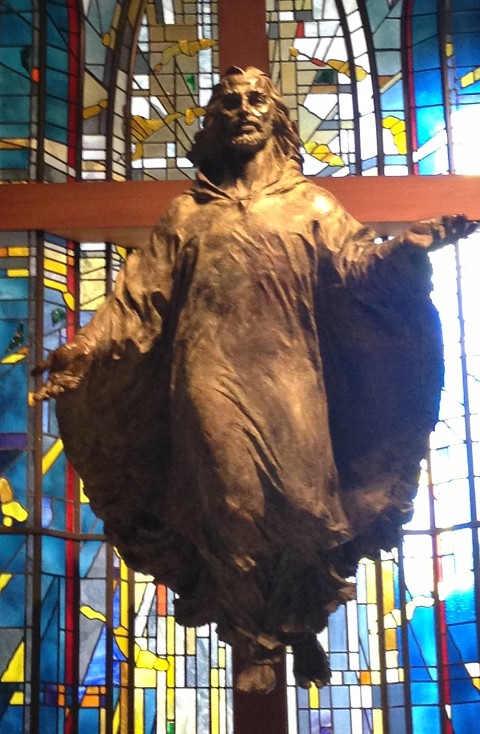
So why the “floating Jesus”?  It’s not the actual name of the church.  But it’s what one of my preschool Sunday School students called the magnificent sculpture that grabs your attention when you walk into the sanctuary.  In an odd way, that I can’t quite explain, the powerfulness of that sculpture washed over me in long forgotten ways yesterday.  This is no wimpy Jesus.  This is a Jesus I want to know and follow.  One that I can be honest with and still know that I can rely on Him.  [He’s also a fun loving Jesus.  Every year on Pentecost we’d walk into the sanctuary and see Him holding a bunch of balloons.]

And Father Gray, in the homily, reminded us that this is the Jesus we release Holly to.  The program for the service says this:  “Christians believe in eternal life through Jesus Christ.  We believed that even before Holly was taken from us.  Today we draw upon that faith and upon its source for strength. … This service is not intended primarily to convey emotional comfort to the bereaved.  This community is presently seeking to do that in other ways over a longer period of time.  This service is shaped to permit us together to do something equally difficult and necessary:  to give God our permission to hold and care for Holly on our behalf. … We are doing this together, not as isolated individuals.”

There was something holy about being part of that.

And there’s something humbling, in a sacred way, about remembering the wide variety of gifts given to me by that particular place and that particular community.  I am who I am because of my time there.