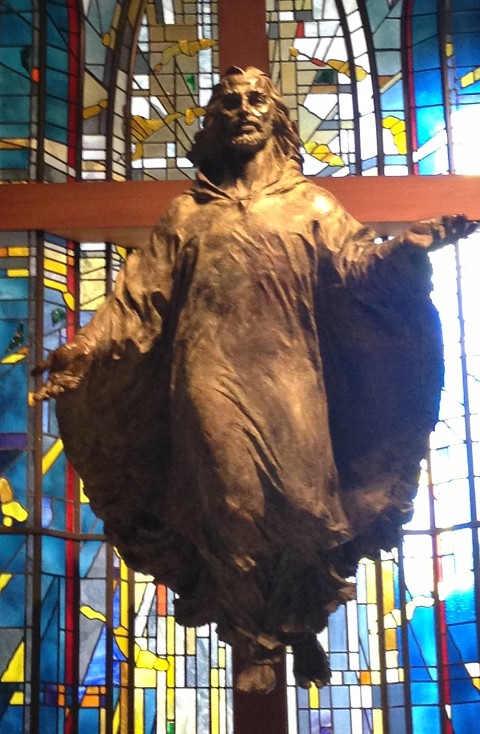
The Church of the Floating Jesus

I didn’t attend this funeral yesterday. It was in November 2012. But my gratitude for this church has not diminished as the years have continued to pass.

Yesterday I attended a funeral – one of those sudden and unexpected deaths that don’t make sense this side of heaven.  A vibrant, full of life, wife and mother collapses without warning and is gone.  Three college/early career age children speak tenderly, and humorously, at the service.  I remember them as toddlers in my Sunday School class and my heart breaks for them.  A husband, so enjoying this stage of their marriage, is denied the joy of growing old with the woman he found so amazing.   Her name is Holly – and the years that eroded the amount of contact we had after I moved away from Atlanta 20 years ago [now 30 years ago] did not diminish that she had a bigger impact on me than she probably ever knew.  If you have a couple of minutes, read her “resume”.  It’s how she introduced herself to potential schools and I promise you it’s unlike anything you’ve ever read in a resume.

The funeral was at the church I attended when I lived in Georgia back then – before the move to Connecticut. Before the move back to Georgia.  It was the place where I’d known Holly and had taught her children in Sunday School.  But it is also the place where God powerfully shaped me.  And those memories flooded me as I sat there.

Father Gray challenged me spiritually and intellectually in a way that opened new worlds to me.  He affirmed ministry gifts in me and encouraged me to step into them, even when I was tentative about doing so.  Even after we moved to Connecticut, he remained a mentor and counselor.  He’s the one who taught me how to navigate some painful relationships – who encouraged me to be truthful instead of always defaulting to “nice”.  He taught me to look poor people in the eye because it treated them with an appropriate dignity.

And there was Nancy, who as Christian Education Director, spoke life and courage into me when I was timid, shy and fearful even in my 30s.  She was a mentor in ways that went so far beyond Christian Education.  She drew out gifts in me – not by pushing me from behind into the unknown, but by standing in front, reaching back, grabbing my hand and playfully leading me forward.  Since retiring from the church, she has become an accomplished artist and one of my most treasured possessions is a portrait she did of my kids for my 40th birthday.

So many more people and so many more things – it’s where I learned about community and about corporate (not just individual) worship and sin and prayer.  It was my first experience in a liturgical church and I discovered an unexpected richness in that.  It fed something in me that I hadn’t even realized was hungry and it connected me more deeply than I’d ever been to the saints who have gone before me. 

It’s the place where I began to come into a sense of who I was, that laid the foundation for all my future ministry, that gave me the tools that years later helped me walk through healing when my life fell apart. 

It opened my eyes to a God who cares about people I’d given little thought to. 

It is where I began to believe that God likes me – which somehow felt more personal and more amazing than the generic “love” I’d grown up hearing about.

So why the “floating Jesus”?  It’s not the actual name of the church.  But it’s what one of my preschool Sunday School students called the magnificent sculpture that grabs your attention when you walk into the sanctuary.  In an odd way, that I can’t quite explain, the powerfulness of that sculpture washed over me in long forgotten ways yesterday.  This is no wimpy Jesus.  This is a Jesus I want to know and follow.  One that I can be honest with and still know that I can rely on Him.  [He’s also a fun loving Jesus.  Every year on Pentecost we’d walk into the sanctuary and see Him holding a bunch of balloons.]

And Father Gray, in the homily, reminded us that this is the Jesus we release Holly to.  The program for the service says this:  “Christians believe in eternal life through Jesus Christ.  We believed that even before Holly was taken from us.  Today we draw upon that faith and upon its source for strength. … This service is not intended primarily to convey emotional comfort to the bereaved.  This community is presently seeking to do that in other ways over a longer period of time.  This service is shaped to permit us together to do something equally difficult and necessary:  to give God our permission to hold and care for Holly on our behalf. … We are doing this together, not as isolated individuals.”

There was something holy about being part of that.

And there’s something humbling, in a sacred way, about remembering the wide variety of gifts given to me by that particular place and that particular community.  I am who I am because of my time there.

I’m So Grateful – I Can’t Give Enough

Originally published in Nov. 2012. Minor adjustments made to update timelines.

About 35 years, my son Andrew had a best friend named Brett.  Brett’s mom (Abby) was blind.  A bump on the head as she went down a water slide a few months after she was married, coupled with complications from diabetes, left her blind.  Every year during the United Way campaign, she spoke morning, noon and night to employee groups.  Her schedule was grueling, her energy completely taken up by this. 

Most people told her she was doing “too much”.  I asked her about it at one point and she said this:  “Almost all of my rehab, the places that taught me how to live a full life as a blind woman, who taught me how to care for a baby as a blind mother – they were organizations supported by the United Way.  I am so grateful.  How can I not give back?  There’s probably nothing they could ask me to do that would be ‘too much’.”

So why am I thinking about that story these days?

When I first heard Abby say that all those years ago, I was struck by how little of that attitude I saw in the church.  The passion to give of ourselves out of gratitude, to say “there is nothing that would be too much to ask because I’ve received so much”.  To give willingly.  To offer everything.  Instead, too often I saw a mentality that seemed more along these lines:  “How little can I get away with giving?  Do I have to tithe from my gross salary or can it be from my net salary?  How much do I have to do in order to be okay with God?”

There seems to be a stewardship sermon season in many churches, often in the fall.  I’ve heard a lot of them over the years – and heard another one on Sunday.  I’ve heard good ones, bad ones, ones that gave me a bigger picture and ones that felt like a scolding.   Ones that made me want to grow in this area and ones that felt totally disconnected from the very real season of life I found myself in.  Some talk just about “trusting”.  Only a few have truly wrestled with the tension between “trusting” and being “wise” or “planning well” (both of which are also scriptural instructions). 

So what are my thoughts?  At the moment, they center on gratitude and generosity. 

Sunday’s sermon was from John 12 – the story of Mary anointing Jesus’ feet with expensive perfume.  It’s extravagant (worth a year’s wages).  It offends Judas who pretends to care about what it would have done for the poor.  It’s far more than any religious law “required”.  Talking about tithing in the context of this kind of generosity  feels almost out of place, as if you wouldn’t need to talk about it to someone who already gives like this.  Years ago a pastor told me that some commentators believe this was part of Mary’s dowry and by pouring it out on Jesus, she may have been sacrificing her opportunities for marriage.  It was a costly gift – but appears to have been given in an attempt to express the depth of her gratitude. 

I love stories where people, in response to a nudge from the Holy Spirit, do something that doesn’t make sense.  I have a friend who once put her earrings in the offering – because it was what she had to give at the moment and even though she knew it would sound “weird”, she also knew she wanted to give whatever she had to the Jesus she loves.

I’ve seen people who are generous with their time – missing things they had planned to do, or going without sleep, because of a chance encounter with someone who needed to be listened to.  Or they take the time to get to know the local convenience store clerk and then become his advocate when a hospital system treats him badly in his dying days because he fits into categories and stereotypes that are not often valued. 

The early church was marked by generosity.  They sold what they had to meet each other’s needs.  They fed and housed each other.  They ate together.  They cared for each other in practical ways.  The generosity overflowed.  It marked them as a “different” kind of people.  Is that distinction still visible today among those of us who claim the name of Christ?

So I’m left with a few challenges.

Do I trust the Lord to provide?  Do I hold on to my resources out of fear or am I truly just planning wisely and appropriately?  How do I find the trust/wise planning balance?  (This is not just financial.  I talked about this recently in my thoughts about Sabbath rest.)

Am I proactively looking for ways to be generous?  Am I always seeking to grow in generosity – of all kinds and of all resources?  Do I hold my possessions lightly?

I think it boils down to this. At my core, does my mind go to “how can I be more generous” or does it wonder “have I done enough to check this off my list”?

Kingdom Journeys

This was written over 10 years ago, but the concept of journey – which was newer to me at that point – still feels like an important discipline in my life. To be honest, revisiting this post makes me wonder if there’s something new waiting to be embraced by me.

Those who know me or who follow this blog know that I’ve been on a journey.  Specifically, starting in the early 2000s, the spiritual journey included walking through the painful end of my marriage and discovering, in the midst of that, new sources for my identity and new depths to my relationship with Jesus.  It has also included the restlessness that would not go away until I allowed the Lord to speak fully into that stage of my life.  For me, there was been a physical journey as well.  At first it looked like mission trips that took me out of my comfort zone and stirred my concern for the world.  It eventually meant a move from Connecticut to Georgia. 

So journey is not a new theme for me.  To be honest though, when this season started in the early 2000s I probably wasn’t actively seeking a journey.  I wanted to continue to grow spiritually – just as I had for the 30 years I’d already been a believer – but I’m not sure I understood journey.  Or maybe I just assumed that spiritual growth and journey were the same thing – that vague “spiritual journey” everyone is on. 

But the last 20 years of my life have definitely been a journey.  I’m not sure that in the beginning I intentionally chose to embark on a journey – with its stages of abandonment, brokenness and dependence.  It feels like circumstances thrust me in the midst of a journey that I wouldn’t have chosen on my own.  But while I may not have willingly chosen to start it, I did choose to embrace it as a journey – to trust that there was a good purpose in it and that, if I allowed it to, it could shape me in life-altering ways. 

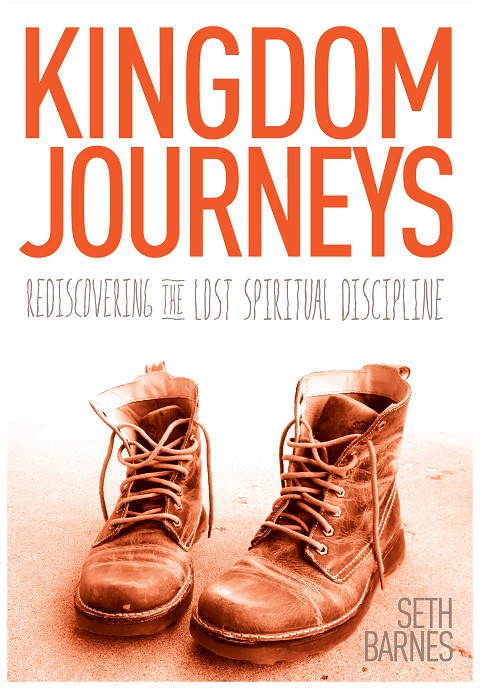
I have a new appreciation for the importance of journey, the subtle ways it is different from other spiritual growth and it’s ability to “accelerate discipleship” or “turbo-charge a person’s faith walk” in the words of Seth Barnes.  Seth, founder and executive director of Adventures in Missions, goes so far as to call it “the lost spiritual discipline”.  In his book, Kingdom Journeys: Rediscovering the Lost Spiritual Discipline, he says “A journey is an act of leaving – a process of physical abandon that teaches us how to do the same spiritually.  Perhaps, to find your true identity you need to abandon everything else.” (p. 22)   

Finding your true identity and stripping away the things that provide false security –  it’s worth doing.  It’s important work for anyone who wants to advance God’s kingdom in the world.  Journey helps you do this.

We see the theme in how Jesus related to His disciples – asking them to abandon everything and follow Him, and then sending them out on journeys without their own provisions.  We see it historically in the idea of pilgrimage. 

What makes something a kingdom journey?  From Seth’s book:  “What sets a kingdom journey apart from gap years, road trips, and volunteer jaunts is the central focus on Jesus’ kingdom.  A kingdom journey is first and foremost about expanding God’s reign in the world and increasing it inside our hearts.”  (p. 55)

I encourage you to let the Lord speak to you about it.  See what stirs in you.  See if your view of the world expands.  See if it confirms you are where you are called to be – or if it feeds a restlessness you may already feel. 

Consider what it looks like if journey is really a life-transforming spiritual discipline.

Sabbath and the Fear of “Not Enough”

I’m still challenged by this (originally written in October 2012).

I’ve posted before about what I was learning in busy seasons.  I was having to let some things go.  But there’s something important beyond just “letting things go” and it applies to all seasons of life. It may get interrupted during particularly busy seasons, but making it a priority, whenever possible, should matter to us.

It involves regular rest.  A decision to not immediately fill my hours with more busyness.  Don’t misunderstand – I want to work hard, I love what I do, I don’t want to lie around doing nothing.  I’m too excited by the work to which I’m called to do that.

But within those parameters, it is wise to rest.  To sleep a more reasonable amount.  I read more.  I’m watch some tv and movies.  I’m have leisurely conversations with friends.  I’m take more walks.  When I first wrote this, I had just gotten a puppy – so I was playing and cuddling and spending time housebreaking him which meant spells of standing outside at night looking up at the stars.  It felt good and right.

And it caused me to think once again about Sabbath rest and why it is so hard to set aside my “to do” list, and my distorted sense of urgency as I look at the things on it.   

Lauren Winner, in Mudhouse Sabbath, talks about the difference between true Sabbath and just “taking a day off”.  I know that my rest still leans heavily toward “taking some time for myself”.  But I want to move toward true Sabbath rest, a day where normal rhythms are set aside and something different happens in the spiritual realm.    

The problem is, whether I say it out loud or not, my mind always goes to “but I have so much to do”.  When is the laundry going to get done, the bills paid, the house cleaned?  I work full time – and I still have all these other things that need doing.  There’s not enough time.

Years ago I learned that tithing or sacrificial giving, for me, is largely about trust.  If I give generously in response to the Holy Spirit’s prompting, do I trust that there will be enough left?  That God will provide for me?  Do I trust that He “will” and not just that He “can”?  It’s been about learning that self-sufficiency is not the goal.

A while back I realized the same principle holds true for Sabbath rest.  If I “give up” that time, do I trust that there will still be enough?  Do I trust the Lord to direct my path – including my “to do” list?  Do I trust Him with the things that don’t get done?

And then I realized there was another, more hidden, fear of “not enough”.  If my identity is tied to being more competent, more productive, harder working – or any other performance-oriented or people-pleasing characteristic – and if I don’t use every minute I can to “prove” that, then will I be able to do enough? Will people still approve of me?  Will I still have value?

It hurts to realize it is a pride thing – and that it impacts my ability to trust God with my time.

But recognizing it for what it is lets me bring it into the light, it lets me confront the lies that shape my identity and it lets me move more undistractedly into the rest I believe I’m called to know and experience.

There are still the challenges of balancing rest with a call that requires a lot of time and energy.  There will still be unavoidable busy seasons.  There are still many tasks that cannot be neglected.

But this much I know – I want to learn to trust God with my time in ways that go beyond where I am right now.  I want to give my all to work and ministry.  And I want to learn to rest deeply and well.

Update (May 2023) – I’ve made progress! Rest comes more easily. I’ve learned to trust. I’ve built rhythms into my life that slow me down – and it helps. I miss “rest” when I don’t get it. I relax more quickly when I do rest. And it is often a very sweet time of just walking through life with Jesus.

Here I Am To Worship

Originally written September 17, 2012. It was a special season.

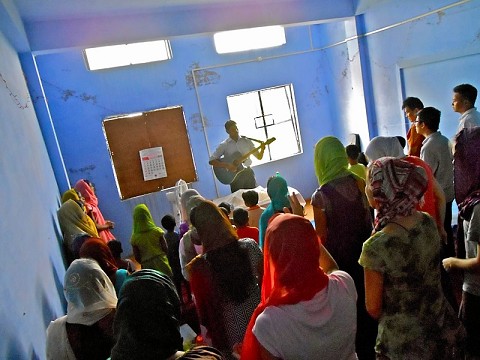
August and September 2012 was a unique season. I attended church at an orphanage in India, at my home church in Georgia, at a megachurch through live streaming and at a bi-lingual Episcopal church in Fort Lauderdale, FL. 

The services ranged from a one-hour tightly scheduled format to a 3 hour liturgical service filled with a mixture of prayer ministry, eucharist, annointing with oil and a way of “passing the peace” that involved everyone moving around the church greeting everyone else (not just those around them) amidst the joyful sounds of English and Spanish.

I’ve had hands laid on me as I’ve been prayed over by children speaking Hindi and a Honduran priest speaking Spanish. 

I’ve heard Indian children sing the same songs we sing at Day Camp in Connecticut.  I’ve watched people who care about revival sing the songs of the 70s that meant so much in that era – and I can remember those early days of discovering a relationship with Jesus.  I’ve worshipped at Adventures in Missions with passionate 20-somethings who know God speaks to his sons and daughters and whose freedom in worship pulls me forward and deeper.

As I realized the amazing diversity of that month, I reflected on a few things:

  1. There is exquisite beauty in this diversity.  These are my brothers and sisters and it feels a bit like a glimpse of heaven – where people from every tribe and nation will gather around the throne singing praises. 
  2. I’m grateful for the wide range of traditions that have shaped my spiritual life.  I was not raised in a liturgical church but at one point spent several incredible years in an Episcopal church and discovered that the liturgy and ritual fed something deep in me that I hadn’t even known was hungry.  I’ve sat under various preaching styles and different types of worship music.  I’ve been in churches that explained away the miraculous and in churches that expected it to happen regularly, where prayer teams saw people raised from the dead through prayer.  In all of these traditions, I’ve met people who love Jesus and worship from their heart.  (And in most of them I’ve also met people who go through the motions with no apparent heart connection.)
  3. My ability to enter into worship depends more on my desire to worship, on my heart’s longing, than it does on the actual style.  This is not to say that we shouldn’t look for a “good fit” in terms of style preference or treaching content when we are looking for a home church.  But those things should never become the defining parameters of whether we can enter into worship at a given moment.

I’ve realized a caution as well.  If I let arrogance or pride slip in.  If I make assumptions about the validity of a particular type of worship.  If I subtly believe I’ve “outgrown” a certain “stage”.  If I overly value the western emphasis on a particular kind of education as the path to spiritual leadership.  Then I miss out on something important. 

My own worship is diminished when I fail to delight in my brothers and sisters in the way God delights in them.  Looking at the external, rather than at the heart, will always cause me to miss what really matters.

It was an amazing month – a gift, a glimpse of what happens when earth begins to resemble heaven.  After this I looked, and there before me was a great multitude that no one could count, from every nation, tribe, people and language, standing before the throne and before the Lamb. (Rev. 7:9)

What 6th Graders Taught Me About September 11 – and taking Jesus seriously

Originally posted September 2012. September 11 continues to be a pivotal moment in our history and I still think about these 6th graders.

They taught me to wrestle with the hard sayings of Jesus.

The anniversary of September 11 rolls around every year. And it brings memories of living through it that first year.  In 2001, the year of the attacks, I was teaching 6th grade Sunday School.  It was part of a spiritual formation program that encouraged discussion and real encounters with Jesus, where we expected the Holy Spirit to speak deep truth to the children.  I’d been walking with some of these sixth graders since they were 4 or 5 years old.

We had started a unit on the maxims of Jesus – sayings of Jesus that help us know how to live.  We had about 20 of them that were part of the unit and we’d talk about a few of them each week.  Sayings such as:

  • This is how it will be with anyone who stores up things for himself but is not rich toward God.
  • No one who puts his hand to the plow and looks back is fit for service in the kingdom of God.
  • I tell you, do not forgive seven times but seventy times seven times.
  • Ask and it will be given to you; seek and you will find; knock and the door will be opened to you.
  • With the measure you use, it will be measured to you – and even more.
  • Give to the one who asks you, and do not turn away from the one who wants to borrow from you.
  • Why do you look at the speck of sawdust in your brother’s eye and pay no attention to the plank in your own eye?
  • Simply let your ‘Yes’ be ‘Yes,’ and your ‘No,’ ‘No’.
  • If someone wants to sue you and take your tunic, let him have your cloak as well.
  • But I tell you:  Love your enemies and pray for those who persecute you.

We had stacks of laminated copies of each of them and every week, at the end of Sunday school, each child would choose one to take home.  It might be one we had discussed that morning or another one that caught their attention.  The idea was to pay particular attention to trying to live by it that week.  On any given week there would be a wide variety of maxims chosen to be the take-home item.

In the midst of this, September 11 happened.  And suddenly, these sixth graders were wrestling with “But I tell you:  Love your enemies and pray for those who persecute you.”  The discussion was real and raw and honest. 

  • “But what Osama bin Laden did wasn’t okay.” 
  • “If we love him, doesn’t that seem like we’re saying it was okay.” 
  • “Does Jesus really mean this?” 
  • “Did stuff like this happen when Jesus was alive on earth?” 
  • “Is it okay to pray that something bad happens to Osama bin Laden?” 
  • “Is it okay to pray that he gets punished?” 
  • “Does loving him mean we have to like him, or what he did?” 
  • “Can you love someone if you are angry at them?”

I sat in awe as I watched them make a commitment to do what Jesus said.  To figure out what that looked like in the aftermath of September 11.  At the end of the morning, every child chose that maxim as the one to take home.  On one level, they didn’t like it.  But on another, they didn’t want to run away from a hard saying.  It would have been easy to choose a different one – but they didn’t. 

Their decision to choose the hard thing, to not look for an “out”, challenged me then and it challenges me now. 

How seriously do I take the sayings of Jesus, the ones that tell me to give away my things, to pray for my enemies, to forgive over and over?  Do I face up to His words and wrestle with them until I can do it?  Or do I choose an easier saying, an easier path?

I know where I want to be.  I want to take Jesus seriously, even when it is hard.  I want to be like those sixth graders.

Is There A Better Question?*

Over the years I’ve found myself having conversations that include the question “Is it okay if I _________?”  [Or alternatively, the declaration that “There’s nothing wrong with ________.”]  I’ve been on both sides – as the one saying those things and the one hearing them.

Sometimes it is a sincere desire to discern God’s will and you are bringing a trusted friend or counselor into that process.  But what about the times when it ends up being a thinly veiled request for “permission” to do something you want to do anyway?  Or a justification for your actions?  When you are primarily covering yourself by making sure that scripture (or some other authority) doesn’t explicitly prohibit it?

The topic can be anything – from what you watch on TV to bending the rules in business or relationships. 

But is it the best question to ask?  Does this question (Is it okay if I …?) really lead us to fullness of life?  Or does it reinforce a minimalist mentality – i.e., how close to the line can I live and still be technically okay?  How little do I have to do?  How much can I get away with?  Doesn’t this draw us toward rules and regulations and checklists as proof that we’re okay with God and others – and therefore doesn’t it keep us under the Law?

I believe there’s a better question, one I learned from Andy Stanley many, many years ago: 

“Is it wise for me to _________ ?”

As stated in the footnote, I originally heard this in an Andy Stanley sermon series.  He expands this question even further: 

In light of my past experiences, my current circumstances and my future hopes and dreams,

what is the wise thing for me to do?

Are you willing to ask yourself that?  I think it’s a harder question than “Is it okay”.  It cuts deeper.  In fact, a hesitation or unwillingness to ask the question is probably a sign of what the answer is.  We can get away with “is it okay (i.e., not specifically prohibited)”.  We squirm more under “is it wise”.

There’s another thing I’ve discovered.  When talking with others, you have an entirely different conversation when you couch it in terms of wisdom rather than right and wrong.  It lets you talk about the uniqueness of their situation – their past, their present circumstances, their hopes and dreams.  You don’t resort to the expected Christian pat answers or cliches.  You are less harsh and judgmental.  They are typically less defensive.  You both stay more relationally engaged. 

A couple of quick disclaimers. 

  1. I’m not suggesting over-spiritualizing everything to the point you feel you never get “time off”.  Caring for yourself, doing things that bring rest and nourishment and fun are wise. 
  2. Don’t use “wisdom” as an excuse for not taking leaps of faith or steps of obedience.  I’m not talking in this post about the worldly wisdom that would discourage you from listening to and following the promptings of the Holy Spirit. 

So – Are you willing to set the bar higher?  To not settle for “okay”.  To change the question from “Is it okay?” to “Is it wise?”  To have different kinds of conversations?

*Essentially everything in this post comes from a sermon series by Andy Stanley published, as best I can remember, as Foolproof Your Life and later as The Best Question Ever and preached, again as best I can remember, somewhere between 2002 and 2006.  This post comes primarily from the first sermon in the series, but to this day I can still tell you the topics of every sermon in the series.  My small group went through the DVDs (it was the pre-download era) and it changed how we talked within the group and how we engaged others in conversation.  All these years later (in 2023), we still use this as a guideline..

The Goal of Parenting (or at least one of them)

The primary part of my job at Adventures in Missions is working with parents of World Racers.  Here’s something I’ve linked for every new group of World Race parents since June 2012.

Eugene Peterson (perhaps best known for The Message paraphrase of the Bible), wrote a book in the early 90s called “Like Dew Your Youth”. It’s primarily geared to parenting teenagers and I don’t remember a lot about the book – except for one key insight that is applicable to all of us who have raised children.

Early in the book he uses the Biblical story of Samuel and Eli (1 Samuel 3:1-10). Samuel had been serving in Eli’s house and one night is awakened by someone calling his name. He runs to Eli asking “What do you want?” Eli, who hadn’t called for Samuel, sends him back to bed. This gets repeated a few times until Eli realizes what is going on and instructs Samuel to answer this way the next time it happens: “Speak Lord, for your servant is listening.” Samuel responds that way and the Lord begins to speak more things to him.

What Eugene Peterson does with this story is set it up as a model of what our goal as parents should be: To transfer the primary voice in our child’s life from our own voice to the Lord’s voice. 

To transfer the primary voice in our child’s life from us to … someone else (the Lord). That is not a small thing. 

Our voice does not necessarily have to become silent, but its use and role changes.

Most parents go through the process of watching their children become adults.  There may be particular times when you enter new stages of this transition.  World Race parents say goodbye to their Racers as they head off for 11 months of ministry around the world.  Their Racers have heard a call. They want to do this crazy, exciting thing called The World Race. Hopefully parents are excited for their Racers, but they’re well aware of what’s going to be hard for them as parents. Even when we see our children “growing in wisdom and stature and favor with God and man”, even when they leave for good and important things, there’s often a hole in our daily life. We miss them. The letting go may feel hard or scary at times.

Most of us say “My children really belong to the Lord, not to me.” But there are times the Lord asks “Do you really mean that? Are you willing to act on that?” When my son was in his mid-teens, I put him on an airplane for a mission trip when I had a strong sense that I would never see him again. I’d battled weeks of this sense, prayed against the spiritual warfare components, recognized my own tendency to fear and all of that. I also knew in my gut that there was no legitimate reason to not let him go on the trip. I knew he was called to it by the Lord. And I knew my own tendency to fear. So I said good-bye, still feeling it was the last time I would see him.

Please note, there is an appropriate protective role for parents to play. Discerning between appropriate protection and appropriate letting go is not always easy. But in this case, I was as sure as I could be that I was not to discourage his desire to go.

There’s a happy ending. He came home just fine. But I had learned an important thing.  When put to the test, I really did believe that my kids ultimately belonged to the Lord – not in a way that releases me from responsibility, but in a way that says I am not to get in the way of them living the life they are called to. And my own spiritual life changed as a result of acting on that. 

John Piper, whose church has a very high vision for spiritual formation in children, said this in a sermon once: (My summary, based on memory) “Parents, if you are sitting in the congregation of this church and your deepest desire is for your children to grow up, get married, live close enough for you to see your grandchildren regularly, have a house/white picket fence/good insurance plan – then you might be in the wrong church and you might want to leave. Because this is fair warning that we intend to go after your child’s heart and our highest hope is that they will give that heart fully to God and His call. And we expect that for some of them that call will take them around the world, into needy and risky places, with no medical care and limited chances for you to see your grandchildren. So decide now.  Is this the right church for you?” 

Everything in us may know that the answer needs to be “Yes” – but the cost is right there in front of us too. This could be a costly “Yes”.

I hope for all parents what we tell World Race parents we hope for them – that the Lord meets you every step of the way, especially if there are hard parts of letting go. We believe He has things to say to you – and perhaps even new calls on your own life.  For World Race parents, we believe their eyes will be opened and their hearts will be stirred by the things they read in the blogs and hear from the Racers. For other parents – I hope you have your own way of discovering what God is doing in the world.  There’s a journey for you in this – separate from what is going on with your children. 

Navigating this process of guiding your children into adulthood, letting go of your children when the time is right, providing encouragement for them to “own” their identity and authority in Christ – these things will give them great opportunities to grow into the men and women of God they are created and called to be. 

This process can also take you to new places of who you are called to be.  Ask Him – “What do you want to do in me as I release my child into Your call on their life?”

My Uncomfortable Relationship With Praying For Healing

Originally written and published May 28, 2012 and I debated doing a major rewrite. But to be honest, I’m still working this out. I have, however, included an update – and I do pray more boldly.

I’ll start with the update. Ten years after I first wrote this, I have grown in boldness. And in praying immediately for someone when a need is mentioned. I still say “I’ll pray for you” – but I’ll also say “Can I pray for you right now?”

Somewhere along the way, I’ve lost most of my fear of “doing it wrong”. And I’ve increasingly let go of my misguided feelings that somehow the outcome is my responsibility.

However, I do still wrestle with the big picture at times. I’ve watched 2 young moms, with very young children left behind, die of cancer in the last year despite huge numbers of people storming the gates of heaven on their behalf. I’ve never believed there was a magic formula to guarantee healing, but some answers of “not now” or “not here on earth” are harder than others.

I’ve watched someone come through pancreatic cancer to health and I’ve seen others die from it. Why did it go one way for one and the other way for the others?

Aging also presents new challenges to me on how to pray. Am I bold enough to pray against the symptoms of normal aging? Is it presumptuous to pray that way? Should I just be praying for grace and peace and pain relief?

So there’s still some uncomfortableness. I don’t have it figured out. But I’m not at the same place I was 11 years ago.

Where I was eleven years ago:

I’ve always had an uncomfortable relationship with praying for healing.  I can  easily get caught up in “What if it doesn’t happen?”  Or “What if I my faith isn’t strong enough to believe it will really happen?  Or “What if this is the Lord’s time to take someone home?”   The magnitude of what I’m asking when I pray for healing seems too overwhelming. And the “risk” of “doing it wrong” feels too high.

I believe in miraculous healings.  I’ve seen them.  I’ve heard stories from people I trust.  So that’s not my problem.  My problem is believing that I’m “good enough” for God to use me to bring it into existence.  There’s a fear that I “can’t do it right”.  And I become tentative.  I know all sorts of things about my identity and authority in Christ – but in this area, it’s been hard for me to move from “knowing it” to “doing it”.

Even early on in my prayer journey, the catchall phrase “if it is Your will” felt wishy washy and self-protective – more about giving me an out than a true desire to acknowledge God’s power and sovereignty. 

Francis McNutt’s book Healing helped some – introducing me to the concept that healing is an integral part of the gospel and not just a sign or wonder that accompanies the gospel proclamation.  In Luke 4:18  Jesus proclaimed:  “The Spirit of the Lord is upon me, because he has anointed me to proclaim good news to the poor.  He has sent me to proclaim liberty to the captives and recovering of sight to the blind, to set at liberty those who are oppressed, ….”  It provided some new theological understanding, but still left me praying tentatively.

Then I discovered Mary and Martha’s approach in John 11.  When Lazarus became ill they sent a message to Jesus saying “Lord, the one you love is sick.”  Throughout John we see people merely stating the problem to Jesus (sickness, lack of wine at the wedding, etc.) without telling Him how He should fix it.

So I clung to that “prayer” – Lord, the one you love is sick [or hurting or whatever the situation was].  It worked great.  It got me off the hook of asking for a specific thing.  And in many situations, it’s still a model I use today and that I believe is a good model when I don’t know how to pray.

Somewhere along the way, in preparing to do the parable of the insistent friend (Luke 11:5-8) in children’s ministry, the simplicity of it struck me.  This parable comes in Jesus’ teaching about prayer and involves a man who goes to his neighbor late at night, after everyone is in bed, to request bread for a visitor who has arrived.  It’s a bold and “inappropriate” thing to do – disturb his neighbor late at night.  But it teaches us that intercessory prayer is boldly going to the One who can meet a need for someone else that we are unable to meet ourselves.  So it helped me take a few baby steps in boldness.

But my hidden secret is that I’m afraid to pray boldly for healing.  I think I’m better at praying faithfully than I am at praying boldly.  And there is a difference.  I believe Scripture affirms both as important but I know the Holy Spirit’s nudge is for me to learn more boldness. 

The reality is that I can usually ignore my discomfort.  But every so often something happens that disturbs this tentative equilibrium I’ve built.  It forces me to face the fear I like to keep hidden. 

This past week [in 2012] at World Race training camp, a young man was healed.  After profound hearing loss for most of his life, requiring him to wear hearing aids, his team prayed for him and he was healed.  The healing is profound. His parents confirmed that.

I hear similar reports on a regular basis – from the World Racers and from others.  And sometimes, those stories begin to nag at me.

 And at least temporarily, my yearning to be bold is stronger than my fearfulness about what won’t happen.

Gratitude and Transformation

From May 20 2012

Erwin McManus, in a couple of the talks I’ve heard him give, has posed this question:  Why are some people transformed as they go through things and other people are not transformed?  Why do some move on, and some stay stuck? 

His conclusion is that gratitude makes a big difference. 

I’m well aware that I’ll always have days here and there when my emotions go up and down.  And there will be days that are harder than others.  But I’m also so aware of what I have to be grateful for.  For instance …

I get to …

  • … spend time with family.  I don’t take lightly that this is a precious thing.  The last few weeks have brought many opportunities – an Easter trip to Chicago to see the kids, a trip to Roanoke to see my mom and sister, a visit from my daughter who lives in Chicago, a trip to the aquarium with my nieces, shared meals with in-laws. 
  • … be part of an organization that disciples teens and 20-somethings in exciting ways.  I love being a part of what God is doing in this generation.  This week I’ll spend a day at World Race Training Camp.  In July we’re launching 3 World Race squads (approximately 150 people) who will spend 11 months bringing the Kingdom to far away places.  I get to watch it happen and meet the people and hear the stories.
  • … open my house to a wide variety of people.  People who are home from mission fields like Peru, or looking to move to Georgia, or preparing to launch long term to Cambodia, Swaziland or Ireland.  People who need a place to stay for a while or people who come just for dinner.  It’s all good.
  • … enjoy a home in a beautiful setting, with plenty to eat and enough resources to do a little bit of pampering of both myself and others. 

I love …

  • … parenting adult children
  • … ministering to parents
  • … making a house a home
  • … cooking/baking
  • … reading
  • … going to movies with friends
  • … talking about both big and little things
  • … seeing water (Lake Lanier and rivers) and mountains as I drive to work (or now, 10 years later, living within walking distance of the beach

I will never forget that …

  • … hard times, and the work put into surviving and getting through them, can bring gifts that last far beyond the end of that particular heartbreak – and which have far wider applicability in your life.  They shape your character, your outlook and your compassion.
  •  … in the hardest of times, I was grateful for His Presence.  God was bringing the recognition that I was stronger than I thought I was and that I had more value than I thought I did.  And seeing myself that way was life-changing.
  • … when who I was as a person and as a woman was most under attack, counselors walked me through the process of accepting that I was deeply loved by my Heavenly Father and by my friends.
  • … when I’ve been underutilized and frustrated in jobs, I’ve learned what it means to find all of my identity in Him – and I’ve learned when to accept a season of “invisibility” and when to step out in faith toward something different. 
  • … when I left friends and community behind in Connecticut, I came to a new place that is bringing life to me in Georgia – and now 10 years later a new community in Georgia and the opportunity to continue to work remotely.

So I’m grateful.  And I hope Erwin is right.  I hope it continues to transform me, to bring me deeper into the heart of God, to make my character and my actions more like His.  I hope it gives me eyes and ears and hands that hear and serve and enjoy and bless others.  That it causes worship to rise plentifully from my lips and my mind and my heart. 

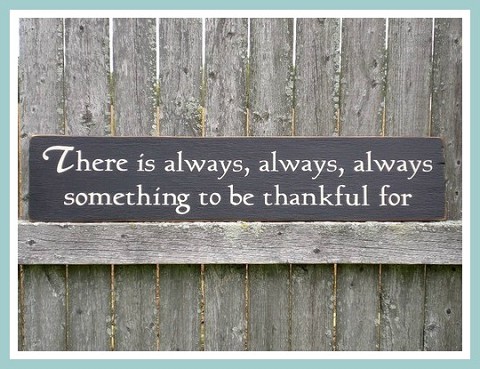
Thanks be to God … who gives good gifts … and who brings deep and real transformation.