Jumbled Thoughts

It’s retirement time (at the end of August).  I’m almost 70 (next March).  My first-born child turns 40 in less than a week (how can that be!)?  I’m a grandmother.  

My goal (set longer ago than I want to admit) to re-energize my writing has not been accomplished.  But I have 2 pages of ideas – just waiting for time to sit with them.  Because I write to process, not just to write on a schedule.  And I don’t post anything unless I think I have something worth saying.  

There are so many great things in my life – friends, people who come visit, walks on the beach, a church home that nourishes me, a great small town to live and get involved in.

But there is sadness as well.  Some is “normal” – friends going through health issues, or difficult situations, or walking through the Alzheimer’s journey with those they love.    

And then there’s a deeper level.  I grieve over the ways the church has not been the church in so many ways and in so many places to so many people.  I grieve that it has not been the life-giving place of freedom for others that it has been for me. And that honest discussions about what the church should look like today face enormous hurdles.

I’m discouraged that community seems so much harder to find in our culture these days.  It feels as if we’ve lost our ability to disagree with each other but remain friends.  The accusations leveled against each other are strong and hurtful and often vile.  The differences between preferences and convictions are ignored. I understand there are make and break issues for people, and there are appropriate places to take strong stands, but the tenor of conversation in general, in our current culture, grieves me.  The breaks in relationship feel wrong. And I don’t completely know how to address it.

I’m confused by and concerned about many of the decisions being made at high levels in our country.  And I have not yet figured out how to add my voice to those discussions in a meaningful way.  But it feels like I need to try.

As all these thoughts swirl around in my mind and my spirit, I’m wanting to speak and act with wisdom and courage and compassion and conviction, where appropriate.  I want to be a safe place for those conversations.  I want to be able to be curious about how others see things without being cut off before we can have a real exchange.  

So in this upcoming season of changes, I want to pause, rest, read, go deep with people and with the Lord, re-engage with Scripture in ways I haven’t done for a while.  I believe there is adventure, growth and calling waiting to be stepped into – even in my 70s – and I want to listen well so I can hear the still, small voice directing my steps.

Boundaries, Grace, Speaking Truth and Healing

Relationships, friendships (close or just acquaintances), committees, small groups and any other combination of people can be messy and sometimes painful..  These combinations can be hard to establish and even harder to maintain.  I’ve seen that clearly, time and time again.

Our stories are unique combinations of high points and low points.  We accomplish, live through, celebrate and grieve so many different things. Our personalities, and our giftedness, predispose us to appear a certain way to others and to ourselves – with all the good points and bad points, making certain connections naturally easier or harder.  Our experiences and the things that have wounded us  make us more sensitive or less sensitive to someone else’s story – and therefore can open up areas where we inadvertently cause pain or react in pain to others.  

It is not an easy thing to navigate through this and form relationships that are healthy and godly.  Relationships that last in healthy ways or that end – and some do need to end – in healthy ways.

It’s not as if there is only one thing to focus on and an easy formula to follow.  Setting boundaries is important.  So is extending grace.  Speaking about things that hurt you is important.  So is recognizing that you may need to help people understand.  Continuing to heal from your own wounds and trauma is essential in learning how to do these things.  Learning to listen to the nudge of the Holy Spirit in any given exchange cannot be underestimated.

For the last few years, I’ve grieved that the ability to have conversations – especially as brothers and sisters in Christ – seems to have eroded.   There are regularly accusations delivered with harshness and an unwillingness (often for all involved) to really listen in an effort to try and understand, or to believe the best about each other, or even to “agree to disagree”.  Conversations are replaced by dialogs where instead of listening we are mentally forming our next point which will provide the defense for our position.  Someone’s comments are attributed to maliciousness or serve as a reason to walk away, rather than as a way to have an encounter that helps both parties grow in understanding of the other one, often learning new ways to care for each other in the process.  

But here’s another wrinkle that is buried in the details of how a conversation goes.  There is truth and standing for truth and justice matters.  Agreeing to disagree is hard, and maybe not always appropriate, when you see a great need, a great injustice, or a situation that feels life-threatening to you.  

So how do we speak the truth in love?  And on the flip side, how do we listen in a loving way.

Jesus perfectly modeled grace and truth.  He also balanced His pursuit of people with His willingness to honor their choices and let them walk away.  But it doesn’t come easily to us.

Much of the time it is complicated.  Some people may be horrified to learn that they hurt someone and will use the situation to grow in wisdom and discernment.  Others may be so insensitive to another’s pain, and so entrenched in their beliefs or their own need to be right, that a conversation makes no difference.  Two people might agree that something is wrong (or right) but not agree on whether there is only one way to address the issue – and be unwilling to really listen to another possibility or to sense that your hearts actually want the same thing.

Those with a background of being hurt, whose story of healing has required them to learn to draw boundaries, may or may not be able to have a conversation – when the possibility of being hurt again is real. Those who are passionate about an issue and have educated themselves about it may have no patience for others who don’t bring the same research and thought.  And so instead of conversations, you have situations where someone doesn’t pass your “litmus test” and you shut them down. And distance becomes entrenched.  And assumptions about “people like that” form deeper roots.

Even the extending of grace – a part of believing the best about someone and often a part of “agreeing to disagree” – can cause problems.  Done begrudgingly, it can create resentment.  It can also get sloppy when it’s not true grace.  It can excuse bad behavior, it can allow abuse to continue, it can avoid hard conversations for the wrong reasons.  Learning to self-advocate, to appropriately speak up for oneself, to be honest about things is important.  So is learning to say “you cannot treat me this way”.  But I also believe there is more grace available to us, and through us, than we often access.  

A pastor once worked hard to convince me that “being truthful” was more Christ-like than “being nice”.  It was hard for me to grasp.  But it was a game changer once I did.  

So – how do we navigate this?  I am someone who, by nature, doesn’t get angry often.  That may sound “nice” but it’s not always healthy.  There are things we should be angry about.  I do know how to get sad though.  So my ways of navigating this may be tipped toward my personality.  

Here are some thoughts.

Learn to recognize the nudge and voice of the Holy Spirit.  As a starting point, that’s essential.  What is right in one situation may not be what is right in the next.  What we can handle on a bad day may be different from what we can handle when we aren’t in stress overload. The details of navigating this are influenced by a myriad of factors, many of which seem to change daily.

Recognize that hurts and misunderstandings are part of doing life together.  I believe being in community is worth this risk.  I also believe the enemy will try to use these things to get a foothold in your life.  And I believe that pursuing healing for ourselves is essential to navigating them well.  

Be prepared to be rebuffed, misunderstood or accused of things you did not do.  Accept that you may get hurt.  Do the right thing anyway but seek the Lord about what that is.  Stay where you are called to be.  Press through.  Remember Jesus who for the joy set before Him endured the cross.  At times, you may need to speak up for yourself and set boundaries.  Other times you may need to lay down your desire to set the record straight – or do it in a way that requires gentleness when you just want to insist.  I believe we can learn to be better at these conversations, but that’s not a guarantee you won’t get hurt.  

Grieve that it may be unfair.  But work hard to acknowledge that and move on. Don’t get stuck there.

Pursue direct conversations, work to keep your heart soft and avoid rumors or gossip.  Honor the instruction in Scripture to go directly to the person – and to not gossip.  As best you can, keep your heart soft.  Being truthful or direct does not preclude being gentle or firm.  We are to speak the truth in love, but also to believe the best about the other person.  (However, see the point about patterns of behavior, below.)  Be open to God doing something in the conversation. That happens more often when hearts are soft.

Ground your true identity in the Lord.  A counselor once asked me “What are you most afraid of?”  My response was “That people who don’t know me will believe what this person says about me.”  He asked “Can you live with that?”  It took a while, but I got there.  And I discovered when (and how) to have the conversations that let me talk about my own perceptions of the experience – and when to just let it go.  

If you are attacked or wounded, accept responsibility for pursuing your own healing.  The hurt is part of living in community and relationship. Yes – it’s often unfair.  But now it is your responsibility to pursue your own healing.  

The person who hurt you may be operating out of wounds that were unfairly inflicted on them.  You can’t force their healing but you can take responsibility for yours.  And perhaps, a bit of compassion creeps in as you recognize you share the reality of being wounded unfairly.

Recognize that hurt can occur even when that was not your intention.  In most cases it is right to start by acknowledging that hurt occurred.  Avoid the false apology of “I’m sorry if you feel hurt” or “I’m sorry if I hurt you.”  Accept that you did hurt them.  It wasn’t your intention.  The accusation might be unfair.  But it happened and acknowledging that is important to the conversion getting to the heart of things. And to the degree that you need to “own” it, do so.  Ask forgiveness if you need to.

Listen well.  If you have listened well to their hurt, it’s easier for them to hear “I’m so sorry.  That was not my intention at all.”  Don’t jump in with your defense prematurely.

Recognize the difference between convictions and preferences.  It’s a variation on “choose your battles”.  Decide whether or not you can remain in relationship.  See if the other person is teachable.  If you can’t stay, or they aren’t teachable, learn to state that in a calm way that explains your conviction and maybe expresses sorrow over the parting of ways.  

Be prepared to draw appropriate boundaries, when it is the right thing to do.  This is sometimes necessary and healthy.  So learn to do it well.  But don’t use “drawing boundaries” as an excuse to avoid conversation.  Be honest with yourself.  Ask trusted friends or counselors for wisdom.  Spend time with the Lord asking Him for His guidance.  And then stand firm in your healthy convictions.

Be humble when someone disagrees with you.  It will take a willingness from both of you to “agree to disagree” but you can initiate the conversation that asks them to help you understand their viewpoint.  They may not be willing.  But you will have done what I believe the Lord asks of you.  The goal is to grow in understanding – not necessarily to come to a complete agreement.  Be open to recognizing how your assumptions affect the conversation.

Distinguish between your responsibility and their responsibility.  You cannot make this happen by yourself.  You can’t argue someone into loving you.  And you can’t always love them into loving you.  We’re still called to love – and love is powerful – but we can’t guarantee they will love (or even like) us back.  They have choices and responsibilities of their own.

Be sensitive to whether you automatically took offense at something that was said or done.  Being offended is different than being hurt.  Taking offense can sometimes keep you entrenched in defensiveness in such a way that you miss out on the possibility of learning and growing and healing.

Consider whether this is a pattern of behavior or a random occurrence.  We need to deal with patterns differently than we do individual events.  A pattern of abuse or insensitivity needs boundaries.  It’s shown itself over time or in various ways.  A comment that hurts in the moment may be very different – perhaps a misunderstanding,  a lack of understanding from a speaker who may be very teachable about why that hurt, or an issue with context.

It’s not easy.  But it’s important.

Does Hope Disappoint?

The last post of the migration from my old blog site to this new one. Written in April 0f 2022, almost 2 years after the previous one and over a year ago. From this point on I’ll be posting new material – but I write as I have things to say, not on any particular schedule. I do have some ideas though ….

Over the almost two years that this space has been silent, I’ve started to write several times.  The phrase “hope does not disappoint” was stuck in my head – a remnant of a verse learned years ago.  Maybe it was because, although the pandemic has been hard for me, I’ve never been without hope.  There was never a time that I didn’t have something to cling to.  

And I hesitate, even now, to write about hope because I am sensitive to the times it has been used as a Christian cliche, a pat answer provided by those who don’t fully experience desperate situations.  I don’t like cliches and pat answers.  I don’t like anything that minimizes that life is very hard for some people or implies that being a believer protects you from that. 

I am acutely aware that while I faced pandemic-related struggles, I have always known I’m one of the fortunate ones.  So what can I say about hope?  I didn’t lose my job.  I had access to health care if I needed it. I didn’t get sick.  I didn’t have to worry about a roof over my head or food on my table.  I didn’t have a parent in a retirement home that I couldn’t visit and who wouldn’t know me the next time I could go to them.  And I didn’t lose anyone close to me.  Outside of pandemic issues, I’m not struggling with chronic pain or terminal illness – either my own or with someone I love.  And I know many who are.

Maybe Easter weekend is a particularly good time to reflect on this.  There’s an old children’s illustration that I’ve used in the past that involves lighting one of those relighting birthday candles – and then giving children the chance to blow it out.  It appears to be extinguished, and then there’s the surprise of the tiny sparks, the faint crackling of a relighting wick, and then it’s back.  Is this a simple picture of the joy of the resurrection, after all appeared lost?  Can this help us understand hope?

I did isolate during the pandemic.  And the weeks and months without face to face contact, or physical touch, or “normal” interactions took their toll.  I felt the sting of being alone in so many ways – no spouse or at-home children to talk to daily.  

So how do I talk about hope in a way that reflects the depth and authenticity it has in my life?  That conveys it is not just a “pat religious answer”.  I was hesitant to publish anything when there was a constant stream of things that made me cautious to post – new Covid variants that shut things down just as they were opening up, a political season characterized by vicious attacks, racial issues that continue to tear our country apart, wars and more.  The world gives us much to be concerned about, and hope may feel further away than it used to. 

I’ve spent time in the scriptures and realized how much Job had to say about hope – a man whose life included the most horrific of losses.  I discovered that hope and expectation are not the same thing.  And there are biblical characters who never saw, in this life, the hope they knew was coming.  Even the remnant of the verse that stuck in my mind – “hope does not disappoint” – has a fuller context.  “And not only this, but we also celebrate in our tribulations, knowing that tribulation brings about perseverance; and perseverance, proven character; and proven character, hope; and hope does not disappoint, because the love of God has been poured out within our hearts through the Holy Spirit who was given to us.”  (Romans 5:3-5 NASB)  

The translation I use these days (ESV) puts it this way – “and hope does not put us to shame, because God’s love has been poured into our hearts”.  At first I didn’t like “does not put us to shame” as much as I liked “does not disappoint” but I’ve come to see that in both translations, hope is “for” us, it is the thing to cling to, the thing that says we are not alone in our struggles.

At a core level, I don’t believe hope is a theological discussion.  I think it’s a heart one, borne out of our stories.  So the best way for me to communicate it is probably not a blog on hope.  It’s in the conversations where someone wants to know what gets me through things.  How did I survive the pain of a marriage ending after 25 years?  What was my cancer journey like?  What I believe about hope is wrapped up in the things I’ve written about trust and learning my value and healing.  It’s inseparable from my experience that God’s love is a safe place for me, that He has my best interest at heart.  

But I’ve realized  I can also consciously choose to make decisions based on hope.  

Some of those may be hard.  I choose to live in hope of a rich and full future, even if my hope and yearning for a companion never materializes.  So I hold the hope of that desire alongside the deep contentment I feel in my current life.  I choose to embrace, and not run away from, hard conversations in the hope that the resulting relationships will be deeper and real – and that I’ll continue to learn that avoiding conflict is not the best way to live.  And I’ll press into hard things.  I choose to publish this blog even though the writing feels clumsy – in the hope that it’s a step toward reclaiming my voice in this space.

Some choices bring immediate joy.  I bought a table for my new home that easily seats 12 – in the hope that I’ll host tables full of people again.  I had diamonds from jewelry that brought memories of a painful period in my life reset into a newly designed piece – to reflect the hope and beauty that comes from healing.  I created a tangible way, through “guest rocks” collected in a decorative bowl, to commemorate the people who visit my home – in the hope that in my new home there will be ongoing opportunities to provide hospitality.  My hope is to see the bowl full of memories of people who have been here.  

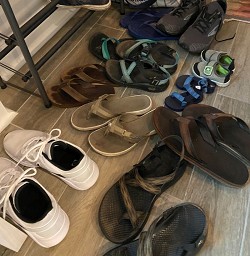
The picture at the top of this blog is an image of hope for me as well.  A pile of shoes that fills me with the hope that my home will be a place for guests, of all generations – a place of peace and rest.

And here we are, on Saturday, between Good Friday and Easter Sunday.  A reminder that there are days when it feels hope has been extinguished.  To live in hope, particularly when it looks like it’s not going to happen, takes courage and faith and trust.  And an openness to not understanding everything, or seeing the whole picture, right now.  As the disciples endured the day we now set aside as Holy Saturday, they thought the hope was over – but it wasn’t.  

For me, I’m not able to live in hope based just on my own abilities or my own skill at navigating my future.  I need the hope based on the love of God, poured out to me.  It has sustained me, nourished me, comforted me, provided surprise gifts and so much more.  It’s what gets me through whatever is going on.  And it does not disappoint.

As New Rhythms Emerge

I’m just about to the end of reposting old blogs. But a few months into the Covid pandemic, in July of 2020, I wrote this.

Although I am not a consistent blogger, this particular stretch of silence has reflected my inability to process in words the new territory we are in as individuals, as a country and as a world.  Others have written beautifully in ways that have ministered deeply to my heart, mind and soul.  But I’ve been unable to write about the deep and big issues in any sort of meaningful way.

Now, several months in, with discussions of racial injustice joining Covid-19 in the public arena, I remain unsure of what to say.  Still, it is time to give an update.  I am coming out of the slowdown and moving into new rhythms that will shape what work and life looks like for the future.

An aside:  This is a personal update about how I’ve been navigating the past few months.  I don’t want to minimize the big picture issues, but at this point I don’t have a lot to say that adds to those conversations.  

I saw the strength, skill and wisdom of the Adventures in Missions staff.  In mid-March, as borders began to close faster than anyone imagined, we brought home 570 international participants, from about 25 squads, in 6 days – working literally around the clock.  Priorities were set and squad locations were reevaluated almost hourly against those filters.  Plans were made and then had to change.  At the home office, departments worked together in unprecedented ways.  Those not on the front lines provided encouragement and food.  Squad leadership cared for Racers deeply disappointed by a trip cut short.  It was Adventures at its best and it felt like a privilege to be part of the team.

The physical reset has been a good one for me.  I have worked at least 50-60 hours a week, being on call for parents essentially 24/7, for several years.  I do love what I get to do and I choose to work those hours.  I do consider that my “job” and my “ministry” morph into one so I expect to pour into it more than a “normal work week”.  But I was tired and overwhelmed.  As the need to serve parents decreased drastically once the Racers were back on U.S. soil, I rested deeply.  I slept more.  My steps per day (which had dropped to an abysmally low level) are back where they should be.  I’ve lost some weight that had crept back on.  And other smaller things feel like a mini-reset as well – turns out I don’t particularly miss having my hair highlighted every few months.  I like that my fingernails are my own again instead of artificially supplemented.  I may go back to some of those luxuries – because I don’t think there’s anything wrong with them – but for now it feels like both a time and budget savings, freeing those resources up for other uses.

I gave myself permission to not feel pressure to “do the big projects”.  This overlaps with resting.  Everywhere I looked people were building things, renovating things, tackling yard projects, painting rooms and every other variety of “big project” work.  And it was an ideal time to be thinking that way – reduced work load, essentially everything on my calendar cancelled.  To move from “to do list” mode to “rest and listen” mode is not always easy.  But it was such a wise decision for me.  And eventually I got to some of those projects and it felt like a leisurely accomplishment that brought great satisfaction.  

The loneliness that never completely goes away has ebbed and flowed with greater intensity.  The lack of a partner to share my life with is felt more acutely.  There is no one to talk to in person, eat with, do life with.  The house is emptier when I can’t host dinners.  Hospitality is constrained in a way that is hard for me.  I’m an introvert, so I know I have it easier than the extroverts do, but it is more of a struggle than I expected.  And I desperately miss face to face community.  Even now, writing this, the tears are closer to the surface than they normally are.

I’m grieving some of the changes.  Between the pre-pandemic decline in participant numbers and the impact of the pandemic on most of our 2020 programs, the Adventures in Missions staff has been reduced by half.  I no longer have a team to work with me in Parent Ministry – and while I am nervous about the workload implications, the deepest grief is the loss of Michelle.  Our friendship will continue – I know that.  But the loss of a co-worker who brought such lift and wisdom and skill is hard.  And it compounds the grief of losing another team member in a layoff a year ago.

The reality that travel is impossible or unwise gets harder. And while I do miss the further flung “fun” travel, it’s the heart connection travel that I miss the most.  Many of the people and places that feed my soul are largely out of reach for a while. I will do the right thing.  But knowing that I can’t go visit friends in Connecticut without quarantining for 14 days upon arrival is hard.  Keeping the need to remain “clean” in mind when you have elderly relatives means you limit contact with the relatives caring more directly for them.  

The world weighs heavily on me these days.  It’s true that I have hope as a believer, but I am deeply grieved and concerned about the issues we’re facing.  Conversations that should have been held in the past are understandably filled with pain and frustration as injustice continues.  Scientific evidence and statistics are disputed and weighed against “rights” as we learn more about Covid. And discussions about the economy are important ones too.  Credentials are questioned. Character and policy are discussed as if there should be an obvious “right” candidate – but both sides feel that way.  Even among brothers and sisters in Christ, there is often a lack of humility, grace and mercy.  Is wearing a mask our way of caring for others?  Or is it a dangerous infringement of our rights that will open the door to irreparable harm?  Or is it just inconvenient?  How do we have the right conversations about racial injustice – and have them in the right way?  What is the right way forward to bring deeply needed change in deeply rooted, sometimes unconscious, thoughts and actions?  And then we get to statements about those who lead our country, or seek to lead it.  The depth of the viciousness and accusations and personal attacks grieve my heart.  How do we speak truth in love in the political arena where there is so much at stake?  What does humility look like in conversations that flow from deep and passionate beliefs.

It’s been a long time since I’ve had this kind of “learning” season.  The need to read broadly, listen well, educate myself and dig deeper is operating at a higher level than it has in a while.  I want to make sure I don’t limit myself to resources and voices that are familiar or safe to me.  I like hearing the perspective of those whose thinking, opinions and experiences are different than mine.  But I also have to ultimately choose who to believe.  Discernment is crucial.  In the end, how do I stay open to being educated but also decide where to land?  At some point, I have to decide whose data interpretation I trust most – and do that in a way that still allows for continued learning and growth.  Whose path forward seems right when tested by my own discernment and my own understanding of the issues.  Whose political agenda is most trustworthy, as best I can discern.

It’s a new era.  And I do believe we are being given an opportunity to reset priorities, to commit to community in new ways, to grow and make some necessary changes.  To learn that contentment does not come from our control of our own schedules and agendas.  To learn to love each other sacrificially.  And to deepen our belief that hope can still sustain us.

Contentment and Yearning

Written in September 2019.

There’s a recurring tension I encounter.  It’s the tension of living in contentment and living with unfulfilled yearning. 

This isn’t unique to me.  I know scripture praises learning to be content in all circumstances and sees godliness with contentment as great gain.  But scripture also tells us to yearn for (hunger and thirst for) things like righteousness. We’re encouraged to be persistent in prayer.  We’re not supposed to be content in the face of things like injustice or evil.

But what do we do when it feels less “invisible spiritual realm” and more “flesh and blood” realm?  When it is not a spiritual desire or a crisis, but is rather a persistent desire that just doesn’t go away, with no clear word from the Lord one way or another.  The things that don’t dominate your life, aren’t necessarily painful, don’t intrude daily, but are never too far beneath the surface.

How do we live in the tension between contentment and yearning?

I love my life.  I love what I get to do.  I love the ministry. I love making a difference.  I love owning a home that lends itself to hospitality.  I love getting to travel. I love that I have friends to connect with.  I love that I’m cancer-free. I’m very grateful for all that.

I’m deeply content. This empty nest season of my life has been healed and redeemed in ways far beyond what I could have imagined 15 years ago.  I also recognize that the depth of my contentment does not come from any of those things I mentioned above.  No job, no person, no possession can fill those spaces in me that require the Lord in order to be deeply and peacefully content in a way that is not shaken by circumstances.  

My ability to live in the tension between contentment and yearning stems from a rootedness that knows my needs are ultimately met by the Lord.  For me, He has been a trustworthy place to take pain and abandonment and abuse and disappointment and cancer and so much more. I trust at a deep level that He is “for me” and not against me.

BUT …

I also experience yearnings that don’t go away.  I don’t live in pain because of them.  They don’t intrude daily.  But they are there.

Some are easy to talk about.  I yearn for the kind of community I experienced in Connecticut before moving to Georgia eight years ago.  For a church that “did church” better than anywhere else I’ve been. For the close friends that come from walking with each other in daily life, through ups and downs, for years.  

Some are harder to talk about.   I yearn for someone special in my life.  Not just for someone to love me, but for someone who would delight in being loved by me.  A companion to share life with. Someone “there” to listen and talk to – rather than having to find someone to share with when I’m lonely or happy or just have something to share.  Someone there in the going out and coming in each day.  

My life is busy and full.  So it is rare that I have enough time to get deeply reflective on this.  But when I do, I’ll be honest – I have more questions than answers as I reflect on what I should do with this yearning.

But I’ve learned a few things:

Don’t let lies gain a foothold.  For me, this took years of work with counselors and with the Lord before it became instinctive rather than requiring intense effort.  I don’t allow myself to go down the path where the “old tapes” play. Where I hear the voices saying I’m not good enough, pretty enough, special enough.  

Don’t get stuck in unproductive places that feed the lies.  I don’t allow myself to fixate on “Why has no one been interested in me in the 15 years since my divorce?” (And the corollary leap that says the reason must be me.)  Comparison fits in here as well: “Why do other people get a second chance and I don’t?”

Ground yourself in truth even if you have to repeat it 50 times a day during the hard times. I cling to what I know is true.  Five years ago the Lord asked me:  “What if this (the possibility of a companion to share life with) is about My timing and not your worth?”  I cling to that.  I press into the assurance that I have been healed from earlier wounds, I am strong, and I have something to offer.  I hang onto the truth that I am well-equipped to be a partner, whether or not that ever happens.  

Be honest about what you want and courageous enough to ask for it.  This is still a tough one for me. I’m not a demanding person. My identity for much of my life has been as “the compliant one”. I’m sometimes a tentative “if it’s okay and if it’s your will” kind of pray-er.  I don’t want to ask Him for something until I’m sure He wants to give it to me. There’s some messed up “need to get it right” stuff in there.  There’s also some healthy willingness to accept that He knows best.  

What’s missing is the fullness of my identity as a beloved daughter and the trust that He knows my heart and ultimately wants His best for me.  I don’t have to be afraid that I might not “get it right’. So I can ask in freedom, knowing that He delights to hear my requests. That not only is it “safe” to dream with Him, but that doing so knits our hearts together in unique ways.  My heart is still catching up to my head knowledge on this one.

Be aware of where your past experiences impact your current fears, actions and desires – and figure out what that means.  I am honest about the places where my past experience impacts my yearning.  Some of my past treatment has created a desire in me to be pursued, rather than to be the one trying to hold things together, to keep someone close who wants to leave.  Basically, when I’m really honest, my wish goes like this: “Any time Lord – but I want him to just drop out of the sky into my lap and pursue me”. I’ve worked with a counselor to unpack the healthy and the unhealthy parts of that desire to be pursued.  As part of that, I’ve looked at things like whether I’ve too narrowly defined what pursuit looks like (i.e., in a way that spares me from any action or risk) and what it would mean to put myself “out there”.  

Take your questions to the Lord.  Spend time listening. My selfish wish is “just drop out of the sky, into my lap”.  But it’s rarely how the Lord works in my life. So, in those moments, when I have time, I find myself with questions like these:

When do I wait for it to happen and when do I be persistent?  What would persistence look like?  How do I admit the depth of my yearning without messing with my contentment?  Is it a good risk or a bad risk to mess with my contentment? Is discontentment a bad thing when it pushes us toward something important?  Does “settling” for contentment mean I miss out on greater joy?

I know my thinking can get convoluted and bogged down.  Time with the Lord brings clarity – and often much more quickly than I thought possible.  It’s where I get the things I cling to as true.

Figure out what hope looks like for you.  I have my days where I give up hope that it will happen – and where I genuinely and peacefully trust the Lord with that.  But I haven’t heard Him tell me to lay down this yearning, to move past it.  

So most days, if I think about it, I live with a tentative hope.  Not one that requires this for a rich and full life, but one that believes my heavenly Father could still surprise me with a gift that would delight my heart and take my breath away.

Be willing to give it up if you know He is asking that.  I’ve had a few unfulfilled dreams, even ones that persisted for years, where I eventually heard a “no”.  Some were instantaneously easy to give up.  Others weren’t.  But obedience is worth it and brings freedom.

Make sure the “important thing” remains the important thing.   Without that, the balance between contentment and yearning is tenuous. 

So I come back to this: I have a trustworthy Father who loves me, and grounding both my contentment and my yearnings in His goodness is what makes living in the tension possible. 

When the News is Good – But Not Profound

Originally written in April 2019, about 5 months after the end of cancer treatment.

It’s been 5 months since my cancer treatments (radiation) ended.  You’ve walked with me in this journey and it’s right for you to be updated.  But to be honest, I keep waiting for something profound to share. And it’s not there.

There are facts.  I was exhausted at the end of radiation in mid-November but 5 months out my energy level has returned.  (For example, at 4 months out I did a 16-day work related trip that involved three 25+ hour travel days, multiple days of 5-6 hour bus rides and more.)  My first post-cancer mammogram – done 5 months after the lumpectomy and 2 months after the end of radiation – was clear. My visits with the oncologist (every 3 months) are routine and uneventful.  

In just about every way, this journey with cancer is over – and with minimal disruption to my life compared to the cancer journey of so many others.  Caught early. Didn’t need chemo. Successful radiation. And so on. I felt like working throughout it and doing the work I love brought life and good “distraction”.  It maintained continuity and minimized the disruption.

It feels almost unfair to claim I’m a cancer survivor because my life was never really in question.  I didn’t come face to face with my mortality in scary ways. There were a few weeks here and there – waiting for the surgery, waiting for test results, waiting for a treatment plan – where I waited in the unknown and my previous posts talk about how I processed that.  But it’s been less than a year since it was discovered and it’s basically completely over. That feels fast to me.

A few things pop up here and there.  There’s a daily pill to take. Those medical forms that you have to fill out for doctor visits – I have to add “cancer” and “radiation” to the list of medical situations I put a check mark by.  The night before my first mammogram, for the first time, the thought of “what if it’s back” popped into my mind – but wasn’t able to gain a foothold based in fear. I noticed some puffy tissue under my arm and had to decide whether or not this is something I call the oncologist about (I did call, she checked it, and it was nothing to worry about).  

But overall this has been an easier journey than some of the other journeys in my life.  I don’t yet see profound lessons from this. And maybe that is because so many of the potential lessons – overcoming fear, absolute trust in the Lord, and so on – are already built into the foundations of my life.  I’m not sure.

So I rest in a season of gratitude.

In the midst of scary news I’ve experienced deep gratitude.  Gratitude for the results of my particular medical situation. For relatives and friends who came to be with me in the midst of the unknown and who were there for all of my doctor visits.  For meals provided when radiation created extreme fatigue. For the notes and texts and cards and gifts that let me know people cared.  For the prayers that were prayed on my behalf.

I don’t take it for granted that this journey has played out the way it has. I look at it with great gratitude.

The Impact of “Just 15 Minutes a Day”

Written in October 2018 during radiation treatment for cancer.

At this point I am somewhere between halfway and two-thirds of the way through my radiation treatments.  And everyone was correct – I’m in and out of there in 15 minutes. Every day, Monday through Friday.

This is by far easier than chemo would have been.  I have nothing to complain about – and everything to be grateful for.  I am constantly aware that my cancer journey is minimally disruptive. My life – and full recovery – has never been in question.  I can’t say that I’ve really had to wrestle with my mortality. It’s been easy to be hopeful and positive. So it is hard to say what I am about to say.

I’m tired of this.  

When I am brutally honest, I’ve realized in the past week that it’s true.  I need to learn to say this and to know I can say this without it being a complaint.  It’s just a statement of fact.

It’s also a statement of fact that I really am “doing well”.  Being tired of something doesn’t have to mean my life is awful – or even particularly hard.

There’s the physical tiredness – which I was told would likely happen.  It’s an odd feeling to not be exerting myself, to physically feel nothing during the treatment and still feel the fatigue growing week by week.  I’ve kept it at a manageable level by doing some wise things. I blocked my work calendar off from 2-5 every day. So I go home right after my 2:45 radiation appointment.  No afternoon commitments. And I take a nap if I need to before finishing up my emails or other work for the day. I’m gratefully accepting meals and offers to walk the dogs so that about half of my days I don’t have to think about that in the evening.  I’m asleep a couple of hours earlier than normal every night. All of these things are keeping the tiredness at a manageable level and allowing me to continue to do most of the things that matter to me.

But I’ve hit a stage where there’s another kind of tiredness as well.  I’m tired of the routine of the treatments. I’m tired of having to slather Aquaphor on the treatment site 3 times a day – and think through my wardrobe choices with the filter of “what won’t be ruined by the Aquaphor”. I’m tired of energy level being a bigger factor in my plans.   Along with that tiredness, I’m afraid of sounding petty – after all, this is minor (compared to many treatment protocols), this is really no big deal (and I know that), and so on.

So what is the Father teaching me in this?

Rest is a gift.  Not only for the physical healing, but for the way it opens up my soul and spirit to peace.

Community is a gift.  Not just the meals and the dog walks, but the prayers and encouragement in other ways.  While there is no real need for anyone to go with me to daily radiation, I’m incredibly grateful for the friends who accompanied me to all the appointments from the biopsy through the start of radiation.  The Body of Christ, functioning well, is irreplaceable.

In the Mr. Rogers documentary that came out this summer (Won’t You Be My Neighbor?), they talked about how there was a lot of silent air time on the show.  For example, the time he watched a second hand go all the way around – without talking as it was happening – to see how long a minute was. One of the producers of the show said this about the show:

“There was a lot of slow time.  But there was no wasted time.”

I like that, and I think it fits here even though the context is very different.

This is a season of imposed slowness for me.  My heart is choosing to not let it be wasted time.

Good News, Gifts and Desires of the Heart

September 2018 – original post. For those of you who know “cancer land” you’ll understand that I’m at the 5-year mark – past the diagnosis 5-year mark and getting close to the 5-year mark from the end of treatment.

What is “just” good news and what makes something a gift?  How do the desires of our hearts fit into the mix?

I received good news a few days ago.  Testing has determined that chemotherapy adds no benefit – at all – to the treatment of my cancer.  So it will be six weeks of radiation (5 days per week) followed by a daily pill for 5-10 years.

That’s good news!  And I immediately felt a release of the tension that I hadn’t realized I had been carrying as I waited to hear.  There’s a lightness now that had been on hold. I can make plans for the fall (taking into account just the increasing level of fatigue caused by the radiation).  The holidays will be after the treatment, not in the middle of it. I won’t lose my hair!. The list of good results goes on and on.

To be honest, it wasn’t the news I was expecting.  So the relief was immense.

But it’s more than good news.  It feels like a gift. My heart’s desire was to not have to go through chemo.  Suddenly, that desire is a reality. And it’s stirring some musings deep in my spirit.

Because if there is a gift, there is a giver.

Had the results been different, that would have been okay.  My faith would not have been shaken. I would not have felt “let down” by anyone.  I would have gotten through chemo the same way my friends have – the same way countless other women do every year.  There’s nothing in me – or in my relationship with the Lord – that makes me feel entitled to being spared “the hard stuff”.  His companionship through the hard times is enough.

The truth is I know how to do “hard” with the Lord.  I have a steadfast trust in His love and His faithfulness toward me.  So much growth has occurred in those seasons. So much good work has been done.  And the gifts embedded in those hard times have been deep and lasting and solid.

But a gift that aligns with the desires of my heart – I’m less sure how to receive that. There’s a level of delight that comes naturally and easily. There’s a nagging dilemma as well.  I don’t expect “special treatment”. I’m not doom and gloom, expecting the worst, but I didn’t do anything that would explain why I get good news and someone else gets bad news.  I didn’t pray harder, believe more, declare more boldly or anything else along those lines.

I’ve always struggled more with understanding the “why me” when I’m on the “good news” or easy side than when I’m on the “bad news” or hard side.  I’m much more likely to ask “Why is my life easier than most?” rather than “Why is this happening to me?” And I can get tangled up in trying to figure out that “why”.

So here’s what is stirring deep in my spirit.  How do I fit all the pieces together? And I keep coming back to …

If there’s a gift, there’s a Giver.

It doesn’t explain everything, but it feels like the place I need to return to, the central truth.

Scripture tells us that every good gift is from above.  This good news is also a good gift. Can I acknowledge that it comes from Him – without getting bogged down in the ‘why me and not others”?

I believe deeply that I have a heavenly Father who loves me and we’re told that if we know how to give good gifts to our children, He does it even better than we do.  Can I draw on the delight I feel giving gifts to my kids and believe that my heavenly Father feels that way (and more) toward me? Can I allow myself to relax into that love without having it all figured out?

As a believer and as a daughter of the King, I do have a spiritual authority and I’m told to approach the throne with boldness and confidence.  I’m told to bring all of my cares to Him. That doesn’t mean I have a magic formula for getting everything I want. Can I fully embrace my identity as a beloved daughter – without being afraid I’ll be perceived as having an inappropriate “sense of entitlement”?

All of these musings stem from the great joy of receiving good news and a good gift. They don’t distract from the joy. They point me back to the heart of God and they challenge me to believe in fresh ways – deep down – that I’m “beloved”. I’m grateful for that as much as I’m grateful to be spared chemo.

And there’s something else that is stirring – quite unexpectedly.  It has to do with how much this aligns with the desire of my heart.  This news wasn’t a need. It wasn’t an expectation. It was just a wish to be spared chemo – a desire to not have to go through that.  And it happened anyway.

To my surprise, I find my thoughts turning to other desires of my heart and I find hope rising in new ways.  Maybe there will be someone to share my life. Maybe there are more times in great and deep community. Maybe there will be times at the beach and times of travel.  

Maybe …

We throw open our doors to God and discover at the same moment that he has already thrown open his door to us. We find ourselves standing where we always hoped we might stand—out in the wide open spaces of God’s grace and glory, standing tall and shouting our praise.

There’s more to come: We continue to shout our praise even when we’re hemmed in with troubles, because we know how troubles can develop passionate patience in us, and how that patience in turn forges the tempered steel of virtue, keeping us alert for whatever God will do next. In alert expectancy such as this, we’re never left feeling shortchanged. Quite the contrary—we can’t round up enough containers to hold everything God generously pours into our lives through the Holy Spirit!  (Romans 5:2-5, The Message)

So the journey continues.  And hope is stirring in some new ways.

“Scratch and Dent” Jesus

Again, written in December 2017, but moved to new platform in a different season.

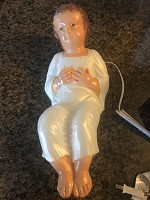
At Christmas, my sister-in-law loves to decorate their yard with an assortment of the older style, illuminated, hard plastic, blow mold figures.  Mr. and Mrs. Claus, reindeer, snowmen, and a Nativity scene. 

Those of us who know her get caught up in her sense of fun and joy.  Her delight spills over to us.  

Unfortunately, a few years ago, someone stole baby Jesus.  (And apparently this is not an uncommon thing to happen in displays like this.)  So I’ve kept my eyes open at flea markets and antique stores but never stumbled across a replacement.  Until …

My sister discovered a website that sold not only new nativity displays, but also replacement figures.  And not just brand new replacement figures.  They had a “Scratch and Dent” Jesus.  The description reads:  Note:  This product will have one or more of any of the following defects: flattened nose, indented nose, paint chips, paint smudge, missing paint or paint splatter.  

I may not “love” the blow plastic molds for my yard.  But I do love a “scratch and dent” Jesus.  This Jesus fits my world better than a pristine, untouchable Jesus.  And it fits me in a season when I have felt a bit bruised myself.  I want a Jesus who knows what it is like to encounter the things that flatten us, or splatter us, or chip us. Who steps right into those things with us. 

The Jesus who was born in a manger, probably more like a cave than the wooden structures we often see.  Among all the smell and mess and dirt of a place that is designed to house animals, not people.  Where swaddling cloths matter because the bed is uncovered straw.

Jan Karon, in At Home in Mitford, shows us a distraught visitor who enters the empty church, sits down, eventually looks upward and in deep agony pleads “God … are … you … up … there?!”  Father Tim slips in beside him and gently says, “You may be asking the wrong question…. I believe the question you may want to ask is not ‘Are you up there?’ but ‘Are you down here?'”

That’s the good news of this season.  That Jesus came. He is “down here”. Immanuel, “God with us”.  And he’s a “scratch and dent” Jesus – not in terms of sharing our sin.  But in terms of sharing our pain and our struggles and the things that hurt us.  Who doesn’t run or retreat when things get messy.  Who takes some of the blows intended for us.  Who binds up our wounds.  Who dwells among and heals the brokenhearted.  

And this Christmas Eve, in the front yard of someone who does love the blow plastic molds, “scratch and dent” Jesus, with his slightly flattened nose, will join the display.  A reminder that the true scratch and dent Jesus has come to bring hope.  And encouraging us to let our joy in Him spill over and draw others into the same delight.

A Full Pantry

The start of my cancer journey. Posted in late June 2018, a few days after my diagnosis. In the original post I didn’t name the “new situation” as cancer. But that’s what it was.

Then Abigail made haste and took two hundred loaves and two skins of wine and five sheep already prepared and five seahs of parched grain and a hundred clusters of raisins and two hundred cakes of figs, and laid them on donkeys.  (1 Samuel 25:18)

This is an obscure little verse in the middle of the story of the interaction between David, Nabal and Abigail.  David and his troops are on the run from King Saul and low on supplies. He sends some of his men to ask Nabal for food.  Nabal sends back a rude and insulting reply. And David tells his men to prepare to attack Nabal’s home.

Abigail (Nabal’s wife) gets wind of what is happening, takes the action in the verse above, and sends provisions to David and his men.  She averts the attack and it’s the beginning of the unfolding of an unexpected story.

What catches my eye here is not just how Abigail was used in a mighty way.  It’s that she had those provisions ready to go in a crisis situation.  She was solidly prepared for an unanticipated event. She had reserves to quickly tap into.  

What if this image of a stocked pantry applies in ways other than feeding hundreds of people?  

The things I’ve learned, the things I’ve experienced, the things I’ve chosen to make foundations in my life – all of these provide reserves to draw on.  They are available to bring to a new situation. My pantry is stocked. It’s partly just decades of walking with Jesus. But a pantry doesn’t get filled up without some degree of intentionality. Without taking what is outside the pantry (but available) and moving it into the pantry.  So in addition to the years involved, it’s also, at least in part, an intentional lifestyle of choosing to grow and to learn and to press in deeper. A willingness to seek counsel and wisdom from others.  A willingness to “count it all joy” when I encounter hardships. A willingness to cling tighter during the rough times, to run toward Him instead of away from Him. A willingness to accept correction in a way that creates intimacy instead of distance.

Once again, I am facing a situation where my pantry supplies are game-changers.  Once again I’m part of a club that I would never have chosen, on my own, to be part of.  The exact details of what that is don’t matter. What matters is that I have resources which allow me to face this with confidence and hope and peace.  

So what are some of the things in my pantry?

  • An absolute belief that God is trustworthy.  “For we know and rely on the love God has for us.”  It’s my “cling to” verse (1 John 4:16) The Amplified version is even better:  “We have come to know [by personal observation and experience], and have believed [with deep, consistent faith] the love which God has for us.”  I believe this because it has been true in my life, not just because I’m “supposed” to say it. I know for sure that my heart is safe with Him.
  • The “peace that passes understanding”.  It is real and available to me. I don’t have to work hard to get there.  It does not mean there are no tears or no grieving. It doesn’t eliminate emotional fluctuations but it provides a solid base from which to deal with them.  And a place to return to so that I can sleep at night.
  • A courageous approach to hard things.  The realization that not only can I endure hard things but I can thrive in the midst of them.  They are survivable. And not just in a barely make it kind of way.  Sometimes in the middle of it and sometimes looking back after the immediate pain or trauma or hardship, I see that an abundance was built into that season.  And I can endure far harder things than I would have imagined I could. That knowledge is now rock solid in my life.
  • Freedom and joy.  I know at a core level that freedom and joy come on the other side of hard things and they are worth the pain of getting there.
  • Healing that is deep, solid and lasting.  The fruit of the excruciatingly hard work I did years ago has carried forward and I do not have to do that hard work all over again.  New situations do not require me to battle the same old tapes or the same old fears.
  • A fun sense of amazement.  I’ve reached a point where, for the most part, the old fears and insecurities are no longer able to get a foothold in my life.  I’m amazed and delighted. Not only do I not have to struggle against them or work hard to separate truth from lie, it’s just fun to realize what God has done in my life.
  • A relationship with my Father that is pretty free of any sense of entitlement.  When I face tough things, it’s largely because we live in a fallen world. As a daughter of the King I have authority to boldly approach His throne and make my requests known.  And I’m learning to do that more readily. But that is different than feeling I’m entitled to being spared the tough things. “Why me?” has never been a consuming question for me, and I’m grateful for the grace that spares me that temptation.

Full pantries are good things!  “Oh, how abundant is Your goodness, which you have stored up for those who [reverently] fear You.  Which you have prepared for those who take refuge in You.” (Psalm 31:19)