
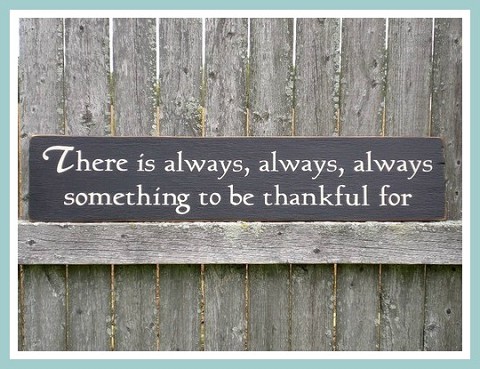
Gratitude and Transformation

From May 20 2012

Erwin McManus, in a couple of the talks I’ve heard him give, has posed this question:  Why are some people transformed as they go through things and other people are not transformed?  Why do some move on, and some stay stuck? 

His conclusion is that gratitude makes a big difference. 

I’m well aware that I’ll always have days here and there when my emotions go up and down.  And there will be days that are harder than others.  But I’m also so aware of what I have to be grateful for.  For instance …

I get to …

  • … spend time with family.  I don’t take lightly that this is a precious thing.  The last few weeks have brought many opportunities – an Easter trip to Chicago to see the kids, a trip to Roanoke to see my mom and sister, a visit from my daughter who lives in Chicago, a trip to the aquarium with my nieces, shared meals with in-laws. 
  • … be part of an organization that disciples teens and 20-somethings in exciting ways.  I love being a part of what God is doing in this generation.  This week I’ll spend a day at World Race Training Camp.  In July we’re launching 3 World Race squads (approximately 150 people) who will spend 11 months bringing the Kingdom to far away places.  I get to watch it happen and meet the people and hear the stories.
  • … open my house to a wide variety of people.  People who are home from mission fields like Peru, or looking to move to Georgia, or preparing to launch long term to Cambodia, Swaziland or Ireland.  People who need a place to stay for a while or people who come just for dinner.  It’s all good.
  • … enjoy a home in a beautiful setting, with plenty to eat and enough resources to do a little bit of pampering of both myself and others. 

I love …

  • … parenting adult children
  • … ministering to parents
  • … making a house a home
  • … cooking/baking
  • … reading
  • … going to movies with friends
  • … talking about both big and little things
  • … seeing water (Lake Lanier and rivers) and mountains as I drive to work (or now, 10 years later, living within walking distance of the beach

I will never forget that …

  • … hard times, and the work put into surviving and getting through them, can bring gifts that last far beyond the end of that particular heartbreak – and which have far wider applicability in your life.  They shape your character, your outlook and your compassion.
  •  … in the hardest of times, I was grateful for His Presence.  God was bringing the recognition that I was stronger than I thought I was and that I had more value than I thought I did.  And seeing myself that way was life-changing.
  • … when who I was as a person and as a woman was most under attack, counselors walked me through the process of accepting that I was deeply loved by my Heavenly Father and by my friends.
  • … when I’ve been underutilized and frustrated in jobs, I’ve learned what it means to find all of my identity in Him – and I’ve learned when to accept a season of “invisibility” and when to step out in faith toward something different. 
  • … when I left friends and community behind in Connecticut, I came to a new place that is bringing life to me in Georgia – and now 10 years later a new community in Georgia and the opportunity to continue to work remotely.

So I’m grateful.  And I hope Erwin is right.  I hope it continues to transform me, to bring me deeper into the heart of God, to make my character and my actions more like His.  I hope it gives me eyes and ears and hands that hear and serve and enjoy and bless others.  That it causes worship to rise plentifully from my lips and my mind and my heart. 

Thanks be to God … who gives good gifts … and who brings deep and real transformation.
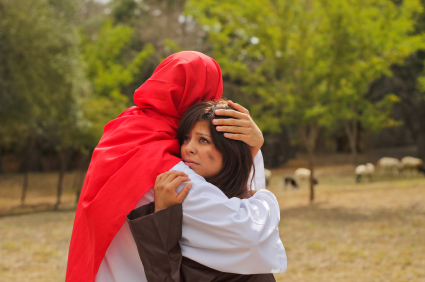
Running Into The Arms of Jesus

IMPORTANT NOTE: This was written over 10 years ago (and originally published May 13, 2012), when certain wounds were fresher and not as healed as they are now. The truth of this blog still holds for me but I am not currently in the middle of this kind of intense pain.

There are times when tears come unexpectedly for me.  When my emotions feel close to the surface, ready to spill over.  A day feels melancholy.  Or I feel knots starting to form in my stomach.  I feel particularly lonely.   Something pokes at an old wound or something hard looms on the horizon.  It feels like the lies I’ve worked so hard to not believe suddenly find new weak points in me to attack.  Or maybe I’m suddenly tired – of working full time, or of having to be strong, or of being alone.  I woke up this morning realizing it was going to be one of those days.

The unexpected part is that most days these same things could exist and they aren’t a burden, I may barely notice them, and they don’t bring tears to my eyes.  I don’t spend my days working up energy to “be strong”.  I enjoy my life – it’s not a constant struggle.  My normal quietness is peaceful, not melancholic. 

So what causes two similar days, in terms of circumstances, to feel so different?  I can usually identify possible triggers for the emotions.  But why are those triggers no big deal most days, yet seem to get their hooks in me on other occasions?

I don’t know why.  I do know I have friends that I can call or ask for prayer.  It’s both good and wise to do that.  I do know that this will pass.  I do know that even on these days, I can have extended periods of good “distraction” – where being with people feels normal and life-giving.  But that doesn’t always “solve” the problem and the emotional fragility returns after that time is over. 

At the core, sometimes I just need Jesus.  Not in my normal quiet times, not in my typical prayer times, not in the wonderful gift of friends.  I just need Him. 

An old hymn, I Will Arise and Go To Jesus, has this chorus:

I will arise and go to Jesus,

He will embrace me in His arms;

In the arms of my dear Savior,

Oh, there are ten thousand charms.

So I run to Jesus, desperate for His arms around me.  Not wanting to talk or think or analyze or take the steps I’ve learned in counseling.  Just wanting to be held.  And knowing that His arms are my safe place, my best protection from the things that hurt and ultimately where I will find what I need.

Is It Conviction? Or Condemnation?

Revised from an original post on May 6, 2021

I’ve been thinking about the difference between conviction and condemnation – and there is a basic truth I come back to time and time again.  This is not a theological treatise.  It’s a general rule of thumb that I believe is true.*

The Holy Spirit convicts of sin.  We know we’ve done something that needs to be taken care of.  Conviction, in my experience, is specific and it relates to the action and not to your identity.  You told a particular lie, you cheated a particular person, you were cruel to someone you know.  You did a particular thing that you know was wrong.

When we bring this to God and others, and take appropriate actions to make things as right as we can with another person,  the relational distance between us and God is taken care of and the Holy Spirit reassures us of that. 

The goal of this type of conviction is the restoration of your sense of relationship.  It creates closeness and intimacy, freedom and joy.   It is based on truth.

Condemnation, on the other hand, is from the enemy.  He may try to disguise it as conviction but condemnation tends to be general rather than specific and it attacks who you are rather than what you did.  “You’re a liar.”  “You always destroy relationships.”  “You’re an awful person.”

Attempts to earn your way out of condemnation (“I’ll try to be better”) don’t work.  Acceptance (“Everything really is my fault.”) leaves you stuck in despair.  And confession can seem to dig the hole deeper – because the enemy has created a scenario that is fundamentally different from conviction.  If you confess and nothing seems to change, it can keep the cycle going by seeming to provide proof that you’re the problem and it’s unsolvable. 

The goal of condemnation is the destruction of relationship.  It creates distance and isolation, bondage and despair.  It is based on lies.

So how do we deal with condemnation? 

  • Learn to identify the “voice”, to be able to discern between conviction and condemnation.
  • Cling to the promise in Romans 8:1:  “There is therefore now no condemnation for those who are in Christ Jesus.”   Don’t let the lies or the partial truths of the enemy rob you of this reality.
  • Let the Lord speak truth to your heart, especially about how He sees you.  Listen for His still, small voice.  Look to scripture.  For example, Zephaniah 3:17 says this:  “For the Lord your God is in your midst, a mighty one who will save; he will rejoice over you with gladness; he will quiet you by his love; he will exult over you with loud singing.”
  • Ask the Lord to examine your heart, to bring conviction where appropriate and to give you courage to make things right with Him and with others.  “Search me, O God, and know my heart!  Try me and know my thoughts!  And see if there be any grievous way in me, and lead me in the way everlasting!”  Psalm 139:23-24.
  • Relax, as much as you can in the midst of your struggles, in His love and trustworthiness.  You don’t have to earn it.  He wants you to feel securely loved.  One of my lifelines has been: “And so we know and rely on the love God has for us.”  (1 John 4:16a).  I’ve clung to that at times when everything else was falling apart, when attacks were coming non-stop. 

So – is it conviction?  Or condemnation?  Is it truth?  Or is it lie?  It’s crucial to learn the difference.

*For this, I’m speaking primarily to those already in relationship with Jesus.  I’m not talking about the work of the Holy Spirit that initially draws us to Him.

Is It Really Good News?

Originally posted in April 2012. But this has continued to be one of the biggest challenges to me personally as I try to articulate to others what my faith means to me.

I’m struck by a particular detail in the story of Jesus’ encounter with the woman at the well in John 4.  It’s not her outcast status or even the fact that Jesus took the unusual step in His culture of having a conversation (a theological one at that!) with a woman.

What I’m struck by is what she says when she runs excitedly back into town.  “Come, meet a man who told me everything I ever did.”  She goes on to wonder whether He could be the Messiah, but her opening excitement is that He told her everything she had ever done – including that she had had five husbands and was not married to the man she was living with. 

And it appears to have been good news to her, freeing news to her, to meet a man like that.  The town knew the details of her life and they used them to shame her.  Jesus knew the details of her life and He used them to bring her into relationship with Him.

It makes me wonder.  When we interact with people, or when we introduce people to Jesus, do they come away feeling they’ve encountered “good news”?  News that produces freedom and life and relationship rather than shame and guilt and distance.  Do we speak of grace but in reality impose law?  Do we exude the abundant life Jesus promises or do we focus on what they have to give up?

Lauren Winner, in her book Real Sex (The Naked Truth About Chastity), says that the church has typically not done a good job of presenting chastity as “good news”.   I think it’s a common problem, impacting many areas of our lives.  We wrestle with the call to holiness and the good news somehow becomes a list of dos and don’ts.

I’m not talking about tossing truth out the window or not ever addressing the issue of sin.  I also know we are called to live holy lives, that we are to be different than the world around us.  Discipleship requires us to address thorny issues.  Our actions matter.  Sin is not to be taken lightly.  Jesus Himself told the woman caught in adultery to “go and sin no more” – but He did so after a grace-filled interaction (John 8). 

At some point I will probably write about confronting people and speaking the hard truth, about facing consequences of unwise or sinful choices, about setting appropriate boundaries.  Scripture tells us we need to do those things and it tells us how to do them.  It’s not that I don’t believe those things are important.  It’s just that it is not what this post is about.

This is about the good news of encountering a God who knows everything about us – all the ugly parts, all the regrets, all the things we would like to keep hidden – but who speaks good news into that in a way that transforms lives.  That makes an outcast woman run into town and invite those who shun her to follow her back to the well because she has encountered someone who changed her life. Jesus was full of grace and truth.  His conversations set people free.  I want to be like that.

Don’t Settle For Peace – Press On To Joy

[Originally written 4/15/12 but there’s a substantial update in this posting. In the last decade I’ve moved more comfortably into joy and what that looks like in me.]

To be deeply peaceful – no matter what the circumstances – is something I’ve learned in the last decade or so.  When I first wrote this, I was coming out of the most painful season of my life. The Lord had worked on the level of fear in my life, I’d been through excruciating grief, I’d wrestled with whether I was lovable.  There had been a lot – and recognizing that I can have deep and abiding and sustaining peace in the midst of those things was one of the gifts of that journey.  There can be a solid peacefulness that co-exists with intense pain.

Peace came pretty naturally to me in those days – and is still a solid pillar in my life now.  When something challenges it, I know the steps to regain it.  It takes more than it used to to disturb the peacefulness I feel, and when it does get disturbed it’s not the same struggle to get back there.  Jesus promised us that His peace is different from the world’s peace – and I’ve experienced that.

But I was once challenged to not settle just for peace, but to press on to joy.   This was earlier in my journey and the advice giver acknowledged that after a long season of pain and anguish, he knew that arriving at a place of peace felt really good.  But he encouraged me to press on until I reached joy.  For the joy set before Him, Jesus endured the cross.  (Heb. 12:2)

But what does joy look like in me?  Ten years ago, here is what I felt: Despite huge amounts of breaking free from it, I’m still shy in most settings.  I don’t have the bubbly personality where joy spills over infectiously.  I’m quieter by nature.  I don’t spontaneously blurt out the things that indicate joy.  Shyness creates unique challenges in this area.  The fear of embarrassment is still a struggle for me.  It seems as if peacefulness suits my personality better than joy does.

But I had a nagging sense that the Lord had more for me.

It’s not that joy was not present.  I did think I had pressed past peace and into joy.  It’s that I didn’t know how to make it visible.  I often think that if I could change one thing about myself, it most likely would be this.  I’d like to be more expressive to those around me – especially in the things that indicate joy and delight.  But there I was, still quiet and shy about it.  

A few days before writing this ten years ago, something caused a blip in my peacefulness and my joy.  It hurt and it was unfair and I spent one evening doing a little bit of grieving.  I brought a handful of people alongside me.  The peace began to flow back in.

And I realized this at that point – the reminder to press on to joy was coming more automatically those days.  It had become an integral extension of peace.  Whether or not I would ever be able to express it in a way that others could see, I did know that the joy of the Lord is my strength. 

In the decade since then, I have learned to be more comfortable with a quiet joy. My shyness is still there, but not as controlling. I still have times when I wish I could be “the fun one”. But I also am very comfortable with who I am.

I still think I live more comfortably in “peace,” but “joy” is also a fruit of the Spirit and I want my life to be characterized by it as well. The Lord has stretched me in the last decade – and I am bit by bit relaxing into it in new ways.

Saying No … to the right things

[This was originally published on 3/26/12 and still resonates with me. For those of us who are “doers”, who are wired to meet needs, it’s hard to say “no” – even when it is the right thing.]

Is it possible that Kingdom work is as much about what we say “No” to as it is about what we say “Yes” to?  This is not headed toward a legalistic, moralistic list of “dos” and “don’ts” related primarily to behavior! It’s also not primarily about saying “no” to harmful, unproductive, or wasteful things.

I believe there are times when we need to say “no” to good things, to unmet needs and to Kingdom work.

There are two stories – almost back to back in the gospel of Luke – that have challenged me for years.  In Luke 4:14-30, Jesus has just finished His testing in the wilderness and He returns home to Nazareth.  He attends the synagogue, reads the Messianic passage from Isaiah 61*, and announces that “Today this scripture is fulfilled in your hearing.”  There’s an exchange with the crowd about no prophet being recognized in his home town and Jesus is driven, by the crowd, out of town to the edge of a hillside where they intend to throw him off the cliff.  “But he walked right through the crowd and went on his way.”  (v. 30).

A few verses later (verses 40-44), we find Jesus in Capernaum at the home of Simon.  Beginning when the Sabbath ended at sunset, people brought a steady stream of the sick and demon-possessed to Him and He healed them.  This continues throughout the night until Jesus retreats to a solitary place at daybreak.  The people find Him and try to keep Him from leaving.  “But he said, ‘I must proclaim the good news of the kingdom of God to the other towns also, because that is why I was sent.’” (verse 43).

So where’s the challenge?  For me it comes in several forms. 

In the midst of people who know me, who may not think I can do something, am I willing to hold fast and trust my sense of call?  To not let their perception of me cloud who God says I am?

For me, a deep rejection which is then followed by an adoring crowd, would make the adoring crowd an enticing place to stay.   Do I have the courage – and the sense of call – to move on, not knowing what is ahead in terms of acceptance or rejection?

Can I leave things “undone” or “unfinished” when it is not my role to finish them?  As I read this passage, my assumption is that there were needs Jesus did not meet in Capernaum.  More sick people.  More demon possessed people.  More suffering.  More people to inspire and nurture.  And He walks away from that.  He says “No” – not always an easy thing for us to say in Christian circles where we are inundated with requests to meet needs.  He says “No” to real ministry opportunities in order to be obedient to His greater calling.

 In many ways, this last one is the hardest for me.  It doesn’t feel right to see what needs to be done and then not do it.  How do I keep my eyes on the bigger picture when the little picture is so immediate and so compelling?   

I don’t have a definitive answer.   I know it involves listening to the Holy Spirit, growing in intimacy with the Lord so that I recognize His voice, and asking others to help me discern. I know that there are small “yeses” that I’m not supposed to stress over.

But even after 20 years [now 30 years] of being challenged by this, I’m not always sure I can say that I know what I am sent to do. So, even at this stage of my life, I long for increasing pieces of that knowledge and the vision of what that looks like – as well as occasional reminders that I am created and sent for a purpose. 

*Isaiah 61:1 – The Spirit of the Sovereign LORD is on me,  because the LORD has anointed me  to proclaim good news to the poor.  He has sent me to bind up the brokenhearted,  to proclaim freedom for the captives  and release from darkness for the prisoners, to  proclaim the year of the LORD’s favor.

Living Radically – in your everyday life (Part Two)

As promised, here’s the rest of my list – things that have helped me grow.  (For the first six items see Part One)

7.   Make no assumptions  that your “normal” life will stay normal.  Small acts of radical discipleship often lead to bigger leaps of faith.

8. Look for opportunities to be generous in non-financial ways.  Be generous with praise, with time, with compassion, with little acts of assistance.  Learn people’s “love language” as part of your generosity to them. 

9.    Experiment with doing things anonymously.  Being invisible for a season can be stretching and can drive you closer to the Father when your other sources of affirmation become unavailable.

10.  Disrupt your routine from time to time.  Continually look for opportunities to get out of your comfort zone.  Do little things regularly (e.g., spend time with someone you wouldn’t normally spend time with) but occasionally do big things as well (e.g., a mission trip).

11.  Admit that boredom is not an option as a lifestyle.  If you are bored, ask Him what Kingdom work you are not seeing right around you.

12.  Distinguish between appropriate self-care/relaxation/leisure and self-medication, avoidance or numbing behavior.  I believe in “down time” and “just fun”.  I spend time on the couch in front of the TV from time to time.  Learn your needs (what nourishes you and refills your tank) but also learn what constitutes an unhealthy or unproductive escape.  Brother Lawrence, in The Practice of the Presence of God, says something along these lines:  “How sad it is to trade fellowship with God for the trivial.”  [My paraphrase.  After all these years I can’t guarantee it’s an exact quote.]

13.  Recognize that your time – as well as your other resources – belongs to the Lord.  And that includes your “job” time, not just your “discretionary” time.  Do you feel a sense of call – either directly or indirectly – in what you do?  Does your job allow you to accomplish or provide for things related to the Kingdom?  Or does it interfere with your Kingdom call?  Is there a persistent nudge from the Spirit that things are not right?  Is there a nagging sense of “something more” that doesn’t go away.  Pay attention.  Ask the Lord what it means.  Is the “location” not right?  Is the work/family balance not right?  Is timing/season of life an issue?

14.  If hard things – job losses, economic shifts – occur, look for God’s hand and consider whether you’re being pushed out of the nest, being forced to do something you wouldn’t do on your own.

15.  Hold “things” lightly.  This is not an “anti-wealth”, “anti-nice things” statement.  It is about availability, about not blindly buying into our culture’s view of consumerism.  Be ready and willing to sacrifice “things”- if called to – for the greater joy of serving the Kingdom.

So, what have I missed?  Any thoughts that should be added to the list?

Living Radically – in your everyday life (Part One)

[This was originally posted on March 18, 2012. The World Race, referenced here, is a program of Adventures in Missions, the organization I work for. Young adults, from 18-30 years old spend 9 or 11 months traveling around the world with just their hiking backpack, working with ministry partners.]

I thought about titling this “How to be a radical disciple without going on the World Race”.  There are circumstances – such as the World Race – that seem inherently “radical”.  The steps of faith, the ministry opportunities, the challenges and the Kingdom impact are all clear.  The routines are less settled.  The stories and pictures “prove” you are living radically.

But what if it is not that clear cut?  What if you have to look for opportunities within your “ordinary” life?  The desire to be a radical disciple stirs in many of us who live more “normal” lives, constrained by full-time jobs, family commitments, stage of life issues and the like.  So how do we live as radical disciples?

I recently found a journal where I had begun to jot down thoughts.  This isn’t a full discussion with all the appropriate qualifiers.  It’s merely some thoughts from years of wrestling and seeking. 

How to live as a radical disciple (the first 6 thoughts – with the rest of the list coming soon):

1. Take listening prayer seriously.  Make a commitment ahead of time to believe that God will speak to you.  Work toward instantaneous obedience when you know it is His voice.   Believe He speaks in the little things (“go talk to that lonely person”) as well as the big things (“move to Africa”).

2. Do not disguise fear as wisdom.  Be brutally honest.  Resist the temptation to dismiss things by saying “I don’t think it is wise to …” when you really mean “I’m afraid to ….”

3. Don’t live self-protectively.  You’ll know what this looks like in your own life.  Maybe you begin to make decisions that the world might consider foolish.  Or when you feel the Spirit’s nudge, you give away more than you think you can afford.  But you make a daily choice to listen to Him first and then to trust Him to provide what you need – physically, emotionally, financially and in every other way.  It is no longer primarily your responsibility to create security in your life.

4. Consider whether you want your life to be characterized by supernatural gifting or only by “inherent talent”.  Obviously there is a lot of overlap.  But I want a ministry in the Kingdom that cannot be explained by my “natural talent”.  I want there to be a component that can only be explained by the presence of God.  Have the courage to ask for that, knowing that it is like jumping off a cliff.

5. Spend time thinking about the difference between desire and call.  I believe there’s a big overlap but I don’t think they are exactly the same.  Learn contentment where you are called and ask Him to open your eyes to see why He has you there.  Commit to His ministry – even if you would have chosen a different one.  Ask Him to align your heart with His in this particular place and this particular season of your life.  [Note: Part Two will have the balancing thoughts on being open to changing your circumstances.]

6. Ask the Lord to show you where you still hold on to a sense of entitlement.  It can be overt (“I’m entitled to a certain lifestyle”) or it can be subtle (“Because of all I’ve gone through, I’m entitled to have it easier for a while”).  A sense of entitlement will rob you of joy.

Part Two coming soon …

Why look back now?

[Note: I originally thought I’d hold off on new content – aside from a bit of context/updating – until I had revisted my journey of the last 11 years. But as I’ve looked back at where I’ve been, I find new thoughts stirring. For instance, it feels right to explain what prompted me to do this at this time. It’s a new part of my story. So I have decided to occasionally interject new content. I will generally identify it as new and it will most likely appear as the featured post, pinned to the top of the blog. This will allow new thoughts to be added, and given attention, while still providing a way to retell the other parts of my journey. Those older journey posts will likely come pretty often. If you’ve already followed that part of my story, feel free to ignore those notifications. If my story is new to you, just know that fairly constant posting will only be for this beginning season.]

One of the things I love about Scripture is it’s ability to impact me differently in different seasons of my life. Not that truth changes. But I see things I hadn’t noticed before. My life experiences give me new filters for looking at it and additional context for processing it. In some cases, with elapsed time I’ve stripped away some inappropriate cultural reading of it. Different things jump out at me depending on my level of woundedness or healing. And so on.

Last fall I was part of a Bible study group that looked at the Old Testament book of Joshua. It’s the story of the Israelites settling in the promised land after 40 years of wandering in the desert. I’m familiar with the events. The book contains the first Biblical character I ever identified with as a quiet teenager just trying to faithfully follow the Lord. There’s a lot of richness in the stories – and plenty of things to wrestle with as well.

I was expecting a good study. I was not expecting a strong challenge.

Over and over in Joshua, we see Joshua encouraging the tribes to “fully inherit” the land. They were occupying it. They were raising families there. They were planting crops and tending livestock and making it home. But the instruction still came to “fully inherit” it.

It was that sense of “there’s more” that struck me, that felt like a new observation. They had stopped short of what God had for them. They were missing out – and I believe they were missing out on both the personal level (God wanted to bless them) and on the role God was calling them to in the world.

In my life, I often feel prompted to “spend time with the Lord”, asking Him a particular question or about a particular subject. I don’t believe there’s one set format for doing that. For me, it might be journaling – writing the question and then writing whatever comes to mind, trusting that any necessary sorting out or discernment will happen as part of the process. It might be taking a walk without listening to anything as I do – just talking to myself in my mind while I try to listen to what the Lord might be saying. Or a similar process while driving. It can be more prayer-like, in the way people tend to think of prayer – but with times of quiet so that I can listen.

And how the Lord speaks to me can vary as well. Impressions, thoughts that feel out of character for me, what comes out during journaling, a sense of peace as I think about certain options, things jumping out at me as I read Scripture or other authors. I’ve learned to be honest with myself and that’s part of discerning what I hear – I tend to know when a challenge is good and right for me, even if I’m tentative or fearful. I also have others that I trust and I can turn to them for their wisdom, discernment and confirmation.

During and after the Joshua study, this was the one of the areas I felt prompted to ask the Lord about: What do You have for me that I have not fully stepped into? Where have I stopped short of something you want me to do (or that you want to bless me with)?

That’s where this blog comes in. For a few months I’ve felt the answer was “writing”. When I first started blogging 11 years ago, I was fairly consistent. It faded over the years – 8 posts in the last 5-1/2 years. I still don’t anticipate blogging on a specific schedule – as I say in “About Me” I only share when I think it’s worth sharing. I don’t have plans to grow this through my own efforts – although I love when friends and readers share it with others. I just believe I’m supposed to start writing again – and since the blogging platform at work has been through some substantial changes which make it more inaccessible, it felt like time to launch on a new platform.

I do know that at times my thoughts, my experiences and my journey resonate with others. It has opened up individual conversations at times in ways that I hope bring encouragement. And it has invited challenges from those whose experiences are different from mine. I love that as well.

So once again I’m stepping out in faith as I relaunch my blog.

The Restlessness is Gone

Update: This was originally published on 3/4/2012. I was less than a year into my new venture – the one I had tentatively stepped into, in large part because I could no longer ignore the restlessness I felt. This describes what I was beginning to feel and I look back with gratitude for the amazing journey it has been.

I realized that the restlessness I referred to in my previous post was gone.  The restlessness that nagged at me for years, that ebbed and flowed but never completely went away, and that was a large part of making the decision to move to Georgia – I hadn’t felt it since I arrived.  I don’t normally make shifts quickly or easily – so the ease with which I slipped into life in Georgia was an unexpected gift.

The previous year I was still hoping that this move was the “next step” I was supposed to take.  How it would work out on a daily basis, or whether it would take care of the restlessness, was still unknown. 

I needed moments like this – when I realized I wasn’t in the same place I was before.  It’s not about moving toward some unattainable perfection or even just “being better.”  It’s a remembering that enriches my relationship with a Father who loves me enough to walk through all of these things with me, who knows who He created me to be and gently moves me more fully into that, a God who says that bringing the Kingdom is an ongoing journey and He needs me fully engaged and prepared and that I don’t have to do that on my own. 

And in this particular instance, the end result was this:  My heart felt at home.

Even in the day to day shifting of responsibilities that characterized much of what I did in the early years of this new season, I didn’t find myself wondering about whether there was a “next step” I was supposed to take right then.  I still expected to be stretched, to have hard times and easier times.  I knew there would be ministries and calls that would grow and unfold in unexpected ways and that would require me to step out in faith.  But there wasn’t the restlessness I felt before.

Much of what I did in these early years looked “ordinary”.  I was not “on the field” or doing “front lines” ministry in the way that most people would define it.  I didn’t have an abundance of pictures that captured the work I was doing.  I didn’t get to hold orphans in my arms on a daily basis or build relationships with those hurting in far corners of the world.  In many ways I could have been working in any office in any organization.  

But I wasn’t working for just anyone.  I am working with Adventures in Missions.  And in the coming years I would build a ministry to the parents of our participants.

More on that, and on my heart feeling at home, coming up …